Last updated 2026-07-24
TL;DR
In Colorado, an assisted living residence (ALR) is licensed by the Colorado Department of Public Health and Environment under 6 CCR 1011-1 Chapter 7. ALRs offer housing, meals, supervision, and help with daily activities but not skilled nursing. They differ from group homes (which serve smaller populations under different rules) and nursing homes (which provide 24-hour medical care).
What is assisted living?
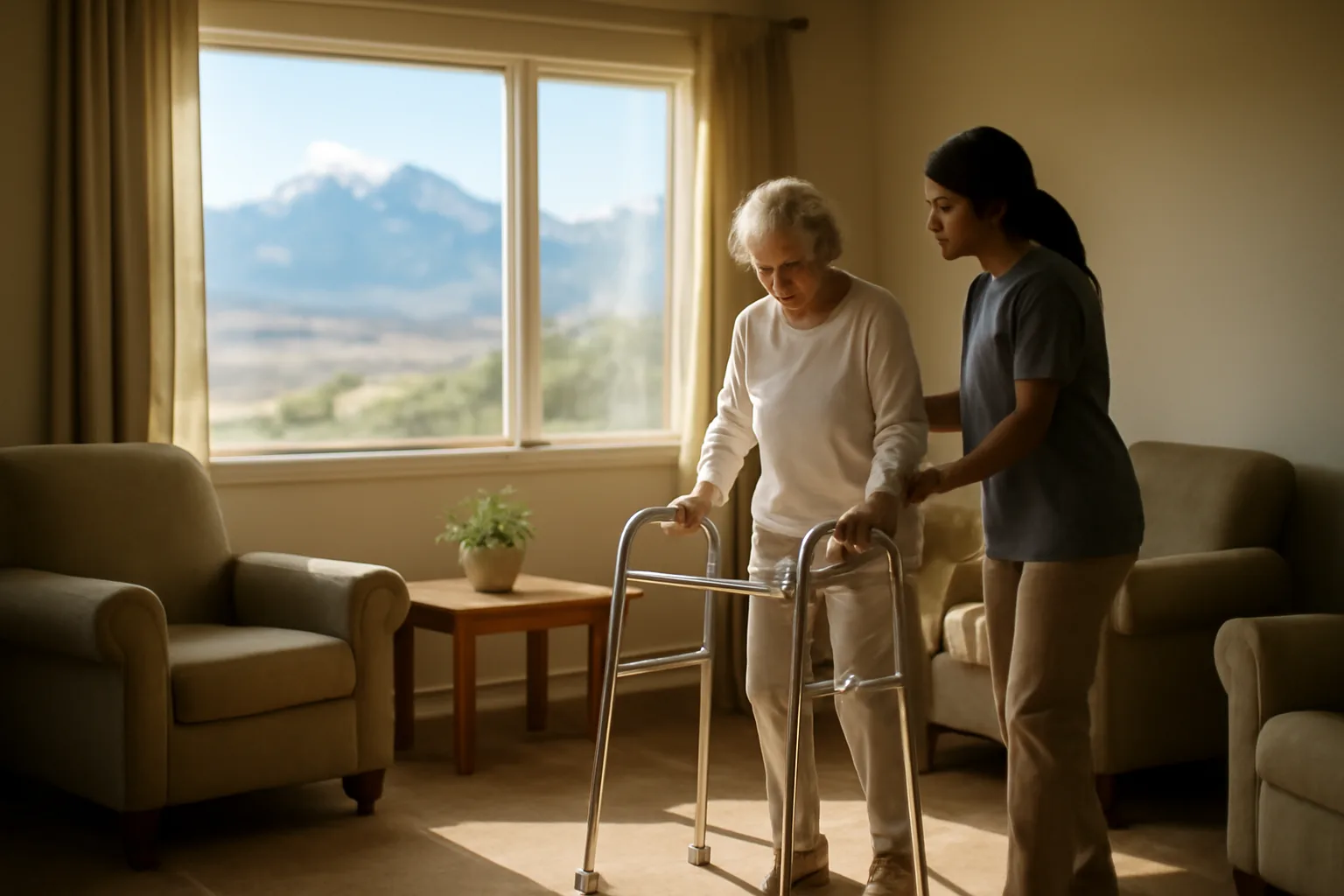
Assisted living is a category of long-term care that combines housing with personal care support, like help bathing, dressing, taking medication, and getting to meals, plus some level of supervision. It sits between fully independent senior housing and a nursing home. Nobody living in assisted living needs round-the-clock skilled nursing care, but most residents need help with at least one or two activities of daily living. In Colorado, the formal license category is "assisted living residence" (ALR), and it's regulated by the Colorado Department of Public Health and Environment (CDPHE), Health Facilities and Emergency Medical Services Division. The governing rule is 6 CCR 1011-1, Chapter 7 [1]. That chapter defines an ALR as a "residential facility that makes available to three or more adults, not related to the owner, room and board and general supervision" along with personal care services [1]. The key word is "general supervision." Colorado ALRs are not medical facilities. They can administer medications, coordinate with home health and hospice agencies, and offer some nursing tasks under specific delegation rules, but they can't function as a skilled nursing facility. If you're picturing a place that looks and feels more like an apartment building with meals and staff on-site than a hospital wing, that's the model.
What is a group home?
A group home is a smaller residential setting, usually licensed to serve people with intellectual or developmental disabilities (IDD), behavioral health needs, or in some states, seniors who need a lower level of care than a full assisted living residence. Group homes typically house somewhere between 3 and 8 people and run more like a family household than an institutional facility, with shared common areas and a smaller staff-to-resident ratio. Colorado licenses several distinct residential categories that fall under the broader "group home" umbrella depending on the population served: host home and group residential services under the Department of Health Care Policy and Financing's Home and Community-Based Services (HCBS) waivers, and Community Residential Homes overseen in partnership with the Department of Human Services. These are legally and operationally different from an ALR license, even though the physical setup can look similar from the curb. If you're comparing which license you actually need, start by asking who you intend to serve. A senior who mainly needs meals, medication reminders, and help getting dressed is an ALR resident. An adult with a developmental disability who needs day programming, behavior support, and Medicaid waiver-funded services is a group home resident under a different license entirely. Mixing up these categories is the single most common mistake first-time operators make in their application, and it can cost months of rework. For the terminology across states, see our overview on assisted living facility licensing categories.
What is an assisted living facility (and what is an ALF)?
"Assisted living facility" (ALF) and "assisted living residence" (ALR) mean the same thing in practice; the term just varies by state. Florida, for example, calls its license an ALF under Chapter 429 of the Florida Statutes, while Colorado uses ALR. Whatever the label, the core definition is consistent nationally: a licensed residential setting providing housing, meals, and personal care services to people who need help with daily activities but not hospital-level medical care. Colorado's ALR license covers many different building types and sizes, from a converted single-family home serving 3 residents up to large purpose-built communities serving over 100. The state doesn't set a hard cap on facility size the way some group home licenses do, but larger ALRs face additional staffing and life-safety requirements. One detail that trips up new applicants: the old "Class A vs Class B" designation used to be part of the ALR rule but was phased out under the 2021 rule revision. Confirm the current classification structure directly with CDPHE's Health Facilities and Emergency Medical Services Division before you build a business plan around an outdated category [1]. Rules get updated, and building your staffing plan or budget around an old version wastes real time and money.
What does assisted living provide?
Assisted living provides a bundle of services centered on daily living support rather than medical treatment. At minimum, a licensed Colorado ALR must provide: - A private or semi-private room, with a bathroom that meets state building code
- Three meals a day plus snacks, with modified diets accommodated
- Help with activities of daily living: bathing, dressing, toileting, mobility, eating
- Medication administration or assistance, per the resident's negotiated service agreement
- 24-hour on-site staff awake and available to respond
- Housekeeping and laundry
- Social and recreational activity programming
- A written, individualized negotiated service agreement (NSA) for every resident, reviewed at least annually [1] What it does not provide, by definition, is ongoing skilled nursing care: things like IV therapy, wound care beyond basic first aid, or ventilator management. If a resident's needs progress past what the ALR license allows, Colorado rule requires the facility to either arrange additional licensed services (like a hospice or home health agency coming in) or help the resident transition to a higher level of care such as a skilled nursing facility [1]. Medication administration deserves its own callout because it's the area inspectors cite most often. Colorado requires that ALR staff administering medications complete a state-approved medication administration training course, and unlicensed staff cannot perform tasks that fall under the Colorado Nurse Practice Act unless properly delegated by an RN [1].
What is assisted living vs nursing home? What's the actual difference?
| Regulating body | CDPHE, 6 CCR 1011-1 Ch. 7 [1] | CDPHE + CMS, 42 CFR 483 [2] | |
|---|---|---|---|
| Medical staffing | No RN required 24/7 | RN required per federal rule | |
| Level of care | ADL help, supervision | Skilled nursing, rehab, IV therapy | |
| Medicare coverage | Not covered | Covered for short-term rehab stays only | |
| Typical setting | Apartment-style or house | Hospital-like wings, shared rooms common | |
| Average monthly cost (national median, 2023) | $5,350 (assisted living) | $9,733 (semi-private nursing home room) [3] | Practically speaking, people move from assisted living to a nursing home when their care needs cross a line the ALR license isn't allowed to cover, most often after a fall, a stroke, or a diagnosis requiring daily skilled nursing intervention. |
The difference comes down to medical intensity and staffing. A nursing home (skilled nursing facility, or SNF) is licensed to provide 24-hour skilled nursing care under the supervision of a registered nurse, and is regulated federally under Medicare/Medicaid Conditions of Participation (42 CFR Part 483) in addition to state licensing [2]. An assisted living residence is a residential, non-medical setting; it is not required to have an RN on-site around the clock, and it is not certified by Medicare. Here's a side-by-side: | Feature | Assisted Living Residence (Colorado ALR) | Nursing Home (SNF) |
Does Medicare cover assisted living facilities?
No. Medicare does not pay for the room and board or personal care costs of assisted living, in Colorado or anywhere else. CMS is explicit about this: Medicare Part A and Part B do not cover long-term custodial care, including assisted living residences, because assisted living is considered a housing and personal-care arrangement, not a medical service [4]. Medicare will pay for medically necessary services a resident receives while living in an ALR, things like physician visits, physical therapy ordered by a doctor, or a home health nursing visit, the same way it would if that person lived at home. It just won't pay the facility's monthly rate for room, board, and custodial care. Medicaid is a different story, and this is where Colorado operators need to pay close attention. Colorado's Medicaid HCBS waivers, including the Elderly, Blind, and Disabled (EBD) waiver, can help cover certain services delivered in an ALR setting for financially eligible residents, but Medicaid still doesn't pay the room and board portion in most cases; residents typically pay room and board from Social Security, pension, or personal funds while Medicaid covers the qualifying care services. If Medicaid funding is part of your business model, get the payer mix and enrollment process confirmed directly with the Colorado Department of Health Care Policy and Financing before you finalize your budget.
How to start a group home in Colorado
Starting a group home (or ALR) in Colorado follows a sequence that's more procedural than complicated, but every step has a real deadline and a real inspection attached to it. Here's the general order, though you should confirm current specifics with the Colorado Department of Public Health and Environment or Department of Health Care Policy and Financing before you spend money on any step: 1. Decide your population and license type. ALR for seniors and adults needing custodial supervision; a Medicaid HCBS-funded group residential license for IDD or behavioral health populations. These have different rules, different funding sources, and different oversight agencies. 2. Check zoning before you sign a lease. Local zoning codes vary by city and county in Colorado, and a residential zone that allows a single-family home doesn't automatically allow a licensed care facility with paid staff. Confirm with your local planning or zoning department. 3. Write your policy and procedure manual. CDPHE requires a written operations manual covering admission and discharge criteria, medication management, staffing plans, emergency preparedness, and resident rights before it will issue a license [1]. 4. Submit your license application and pay the fee. Fees and required documentation change periodically; confirm current fee schedules and forms directly with your state licensing agency rather than relying on older published numbers. 5. Pass a pre-licensing survey (inspection). CDPHE conducts an on-site inspection to confirm life-safety code compliance, staffing ratios, and physical plant requirements before issuing the initial license [1]. 6. Hire and train staff to the required ratios. Colorado sets minimum staffing based on resident needs and facility size, and administrators must meet training and, in some cases, certification requirements. 7. Maintain ongoing compliance. Licenses require periodic renewal and are subject to unannounced inspections and complaint investigations. This is the point where a lot of first-time operators either get overwhelmed by the paperwork volume or underestimate how long the zoning and building-code review can take, sometimes longer than the license application itself. If you want a structured starting point for the paperwork side (policy manual templates, staffing plan worksheets, application checklists), our State Group Home Licensing Kit is a $299 one-time toolkit built around this exact sequence, though the actual license only comes from your state agency.
How do I start a group home? (the shorter, practical version)
If you want the condensed version: pick your population, confirm zoning, write your policies, apply, get inspected, staff up, open. That's six steps, but each one has sub-tasks that can take weeks. The part people underestimate most is the policy and procedure manual. States don't just want a general statement that you'll "follow all applicable rules." CDPHE, like most state agencies, wants specific, facility-tailored procedures: your medication error protocol, your fall-response protocol, your resident grievance process, your emergency evacuation plan mapped to your actual building [1]. Generic templates pulled off a random website often get rejected because they don't reference your specific address, your specific staffing plan, or your specific resident population. The second most underestimated part is capital. Even a small ALR needs a building that meets residential life-safety code (sprinklers, fire alarms, accessible bathrooms), and retrofitting an existing home to meet those codes can run into real money before you've admitted a single resident. Get a life-safety code walkthrough from your local fire marshal or a licensed consultant before you sign any lease or purchase agreement. See our related breakdowns on assisted living facilities licensing across states and assisted living at home models if you're weighing a smaller, home-based approach versus a larger purpose-built ALR.
What's the difference between assisted living and a nursing home, in terms of licensing and inspections?
Beyond the care-level difference already covered, licensing and inspection frequency diverge too. Colorado ALRs are inspected by CDPHE on a schedule tied to complaint history and licensing renewal cycles, with unannounced surveys possible at any time [1]. Nursing homes face federal survey requirements under CMS. Nursing homes must also report quality measures to CMS and appear on the federal Care Compare website with star ratings; Colorado ALRs are not part of that federal reporting system because they aren't Medicare-certified [4]. That's a meaningful distinction for consumers doing research, and it's also a meaningful distinction for operators: nursing home compliance carries federal survival-of-license stakes tied to Medicare/Medicaid certification, while ALR compliance is governed purely at the state level.
How much does assisted living cost in Colorado, and who pays?
Costs vary widely by region, unit size, and level of care, but the most recent nationally cited benchmark is Genworth's Cost of Care Survey, which put the median monthly cost of assisted living in the United States at $5,350 in 2023 [3]. Colorado's urban markets (Denver metro, Boulder) tend to run above the national median; rural and mountain-adjacent facilities can run below it, though nobody publishes a single authoritative statewide average that's updated in real time, so confirm current local rates directly with facilities or your local Area Agency on Aging. Most residents pay out of pocket from savings, Social Security, or long-term care insurance. Medicaid's HCBS waivers can help cover the personal care and service component for financially and functionally eligible residents, but as noted above, room and board is generally a separate, resident-paid cost. Veterans may also qualify for VA Aid and Attendance benefits, which can help offset assisted living costs, though that program is administered by the Department of Veterans Affairs, not Colorado's licensing agency.
What questions does an inspector actually check during a Colorado ALR survey?
CDPHE surveyors work from the standards in 6 CCR 1011-1 Chapter 7, and in practice they focus heavily on a handful of recurring areas: medication administration records and staff training documentation, negotiated service agreements being current and resident-specific, staffing ratios matching the posted schedule, life-safety equipment (fire alarms, sprinklers, exit signage) being tested and logged, and resident rights postings being visible and accurate [1]. Complaint-driven inspections can happen at any time and often focus narrowly on whatever the complaint alleged, whether that's a medication error, a fall, or a staffing shortage on a specific shift. Keeping your own internal audit trail (incident logs, staff training certificates, medication administration records) up to date isn't just good practice; it's what turns a routine inspection into a quick visit instead of a multi-day one.
Frequently asked questions
What is assisted living, in simple terms?
Assisted living is a licensed residential setting where people who need help with daily activities, like bathing, dressing, or medication reminders, live in a home-like environment with staff available 24 hours a day. It is not a hospital or nursing facility; it's housing plus personal care support, regulated at the state level.
What is a group home, and how is it different from assisted living?
A group home is typically a smaller residential license, often serving people with intellectual/developmental disabilities or behavioral health needs, funded through Medicaid HCBS waivers. Assisted living residences (ALRs) generally serve seniors needing custodial care. The populations, funding streams, and licensing rules differ even though both are residential care settings.
What is an assisted living facility?
An assisted living facility (called an assisted living residence, or ALR, in Colorado) is a state-licensed residential building that provides housing, meals, supervision, and help with daily activities to adults who need support but not skilled nursing care. Colorado regulates ALRs under 6 CCR 1011-1, Chapter 7.
What is assisted living vs nursing home?
Assisted living provides housing and help with daily activities without 24-hour skilled nursing staff. A nursing home provides continuous skilled nursing care under RN supervision and is certified by Medicare and Medicaid under federal rules (42 CFR Part 483). Nursing homes handle higher medical acuity; assisted living handles custodial-level needs.
What does assisted living provide exactly?
At minimum: a room, three daily meals, help with bathing/dressing/mobility/medication, 24-hour awake staff, housekeeping, laundry, activity programming, and an individualized written service plan reviewed at least annually. It does not provide ongoing skilled nursing, IV therapy, or ventilator care.
Does Medicare cover assisted living facilities in Colorado?
No. Medicare does not pay for room, board, or custodial personal care in assisted living anywhere in the U.S., including Colorado. Medicare may still cover medically necessary services (doctor visits, ordered therapy) a resident receives while living there, just not the facility's monthly rate.
How do I start a group home in Colorado?
Decide your population and license type, confirm local zoning allows the use, write a facility-specific policy and procedure manual, submit your application and required fee to the appropriate state agency, pass a pre-licensing inspection, staff to required ratios, and maintain ongoing compliance through renewals and unannounced surveys.
What's the difference between assisted living and nursing home costs?
Nationally, Genworth's 2023 Cost of Care Survey put median assisted living at $5,350 a month versus $9,733 a month for a semi-private nursing home room. Nursing homes cost more because they staff to a higher medical acuity level around the clock, including licensed nurses.
Can Medicaid pay for assisted living in Colorado?
Colorado Medicaid HCBS waivers, like the Elderly, Blind, and Disabled (EBD) waiver, can help cover qualifying personal care services delivered in an assisted living setting for eligible residents. Room and board is usually still paid by the resident separately. Confirm eligibility rules with the Colorado Department of Health Care Policy and Financing.
How many residents can a Colorado assisted living residence have?
Colorado's ALR license applies to facilities serving three or more unrelated adults, with no fixed statewide cap on maximum size, though larger facilities face additional staffing, fire-safety, and building-code requirements. Confirm size-specific requirements directly with CDPHE's Health Facilities and Emergency Medical Services Division for your specific building.
Who inspects assisted living facilities in Colorado?
The Colorado Department of Public Health and Environment (CDPHE), through its Health Facilities and Emergency Medical Services Division, licenses and inspects assisted living residences under 6 CCR 1011-1, Chapter 7. Inspections include pre-licensing surveys, periodic renewal surveys, and unannounced complaint investigations.
What license do I need for a memory care unit in Colorado?
Memory care in Colorado usually operates as a specialized designation within the ALR license (dementia care disclosure requirements apply under state rule) rather than a separate license category. Requirements around staffing, training, and secured units apply on top of standard ALR rules; confirm the exact designation process with CDPHE.
Sources
- Colorado Department of Public Health and Environment, Assisted Living Residence Rules: Colorado's assisted living residence definition, service requirements, medication administration rules, and inspection standards under 6 CCR 1011-1 Chapter 7
- Code of Federal Regulations, 42 CFR Part 483 (Requirements for States and Long Term Care Facilities): Federal requirements for skilled nursing facility staffing, surveys, and Medicare/Medicaid certification
- Genworth Cost of Care Survey 2023: National median monthly costs for assisted living ($5,350) and semi-private nursing home rooms ($9,733) in 2023
- Medicare.gov, Long-Term Care coverage information: Medicare does not cover long-term custodial care including assisted living room and board
- 42 CFR 483.30, Nursing Facility survey frequency requirements: Federal requirement that standard nursing facility surveys occur on average no later than 15 months after the previous survey