Last updated 2026-07-25
TL;DR
A group home provider is a person or company licensed by a state agency to operate a residential facility housing people with disabilities, mental illness, or seniors needing daily support. Becoming one means passing a background check, meeting staffing and building codes, and submitting a license application, typically taking 3 to 12 months depending on the state.
What is a group home provider?
A group home provider is the licensed individual or business entity legally responsible for operating a residential care facility. That's the person whose name is on the license, who answers to the state during inspections, and who carries liability if something goes wrong. The term covers a lot of ground. A provider might run a home for adults with intellectual or developmental disabilities (IDD), a residence for people in mental health recovery, an adult foster care home for seniors, or a substance use recovery house. Each of these has its own state licensing category, its own rulebook, and often its own state agency. There's no single national "group home license." Instead, each state's health department, department of social services, or department of developmental disabilities runs its own program, and the requirements differ enough that a provider licensed in Ohio can't just move to Texas and operate under the same paperwork. Most states require the provider (sometimes called the "licensee" or "administrator of record") to pass a criminal background check, complete specific training hours, and demonstrate financial capacity to run the home. Some states require the provider to live on-site (common in adult foster care models with small home sizes); others allow an absentee owner who hires a full-time administrator [1]. If you're comparing this to the broader category of licensed senior housing, see our guide on assisted living facilities.
What is a group home, exactly?
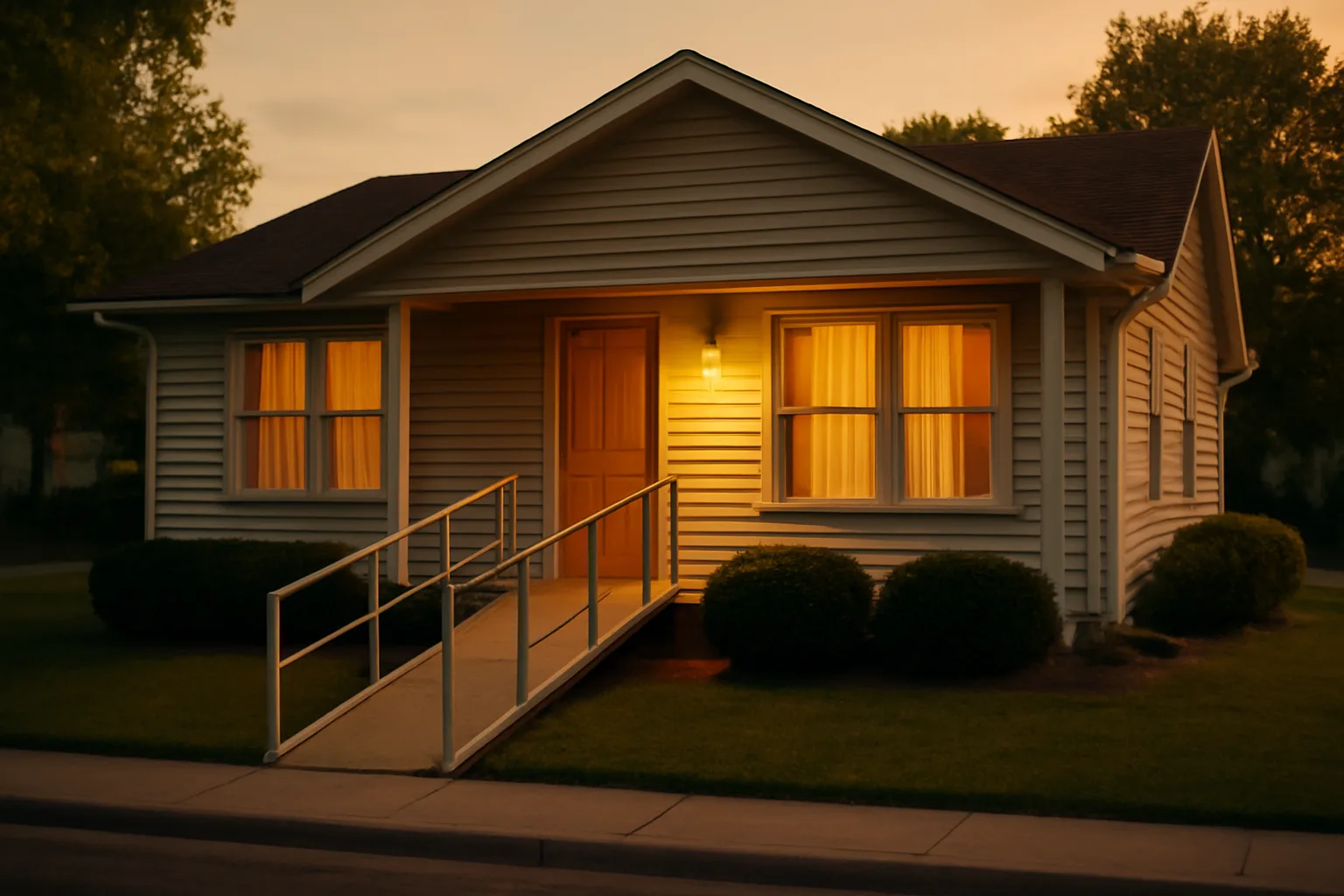
A group home is a residential setting, usually a house or small building, where a small number of unrelated people live together and receive supervision, personal care, or treatment services from paid staff. It's not a hospital and it's not an apartment complex. It sits in between: home-like, but staffed and regulated. Group homes serve different populations depending on the state license type. Common categories include: homes for adults with IDD (often licensed under Medicaid HCBS waiver rules), residential mental health facilities, adult foster care or adult family homes for seniors, and substance use recovery residences. Capacity is usually capped low, commonly 4 to 10 residents per home, because most states define anything larger as an "institution" subject to different (and stricter) rules. The Centers for Medicare & Medicaid Services (CMS) defines home and community-based settings partly by this smaller, more integrated scale, which is why most group homes intentionally stay under those thresholds [2]. Staffing in a group home ranges from awake overnight staff with 24/7 coverage (common in IDD and mental health group homes) to a live-in caregiver model in adult foster care homes. Either way, the state's rules on staff-to-resident ratios, training hours, and required certifications (like CPR, first aid, and medication administration) drive most of the day-to-day operating cost.
What is an assisted living facility, and how is it different from a group home?
An assisted living facility (ALF) is a licensed residential setting, typically for seniors, that provides housing plus help with activities of daily living such as bathing, dressing, medication management, and meals, but not skilled nursing care. It's regulated at the state level, usually by the same agency that licenses nursing homes, but under a separate, generally less clinical set of rules. The line between "assisted living facility" and "group home" gets blurry because states use different terms for overlapping concepts. Some states call small assisted living settings (6 beds or fewer) "residential care homes" or "adult family homes," which functionally look like group homes. Others reserve "group home" strictly for IDD or behavioral health populations and use "assisted living" only for senior care. If you're trying to figure out which license category applies to your project, start with our breakdown of assisted living and assisted living facility licensing basics, then confirm the exact category name and rule citation with your state licensing agency, because the label matters for which inspection checklist and staffing ratio applies to you. Generally speaking, assisted living facilities skew larger (20 to 100+ beds is common) and more amenity-driven (dining rooms, activity directors, transportation), while group homes tend to be smaller, more home-like, and built around a specific population's support needs rather than a hospitality model.
What does assisted living provide day to day?
Assisted living provides a private or semi-private room, meals, help with daily activities, medication oversight, and 24-hour staff availability, but it does not provide hospital-level medical care. Most states require assisted living residents to be able to direct their own care or have a responsible party who can, which distinguishes it from a nursing home. Typical services bundled into an assisted living rate include: help with bathing, dressing, and toileting; medication reminders or administration depending on state rules; three meals a day plus snacks; housekeeping and laundry; and some level of social or recreational programming. Nursing services, if offered at all, are usually limited (a visiting nurse a few hours a week) rather than around-the-clock skilled care. Medicaid coverage of assisted living services varies enormously by state and is usually delivered through a Home and Community-Based Services (HCBS) waiver rather than as a standard Medicaid benefit. CMS's HCBS guidance notes that states can choose to cover "personal care services" and "residential habilitation" in home-like settings through waiver authority, but room and board is typically excluded from what Medicaid will pay [3]. That means a resident's rent and meals often come out of pocket or through Supplemental Security Income (SSI), even when the personal care portion is Medicaid-funded.
What is assisted living vs nursing home: what's the real difference?
| Regulator | State licensing agency | State agency + federal CMS certification | |
|---|---|---|---|
| Staffing | Caregivers, medication aides; RN/LPN often part-time | 24-hour licensed nursing staff required | |
| Medicare coverage | Generally not covered | Covered for qualifying short-term skilled stays | |
| Medicaid coverage | Varies, usually via HCBS waiver, room/board excluded | Covered as a mandatory Medicaid benefit in all states | |
| Typical resident | Needs ADL help, is medically stable | Needs skilled nursing, rehab, or complex medical care | Nursing homes must meet federal requirements under 42 CFR Part 483 because they bill Medicare and Medicaid directly for skilled care [4]. Assisted living facilities are licensed entirely at the state level; there's no federal assisted living certification. That's part of why assisted living rules vary so much state to state, and why a provider expanding across state lines has to rebuild their compliance approach for each new state rather than reuse one license. |
Assisted living is for people who need help with daily activities but not full-time medical or nursing care. A nursing home (also called a skilled nursing facility) is for people who need ongoing medical supervision, rehabilitation, or nursing-level care, and it operates under federal Medicare/Medicaid conditions of participation, more than state licensing. The biggest practical differences: | Feature | Assisted living | Nursing home |
Does Medicare cover assisted living facilities?
No. Medicare does not cover the cost of room and board or personal care services in an assisted living facility. Medicare Part A and Part B cover medical services (doctor visits, hospital stays, some home health, short-term skilled nursing after a qualifying hospital stay), but they do not pay assisted living rent or the daily supervision/personal care fees. Medicare.gov is direct about this: assisted living is generally categorized as a non-medical, custodial service, and "Medicare doesn't cover long-term care (also called custodial care)" [5]. If a resident in assisted living has a Medicare-covered medical visit, home health service, or durable medical equipment need, Medicare can pay for that specific service, but it will never pay the facility's monthly rate. This is one of the most common points of confusion for families and new providers alike. People frequently assume that because Medicare covers a hospital stay or a skilled nursing stay after surgery, it will also cover assisted living. It won't. Payment for assisted living typically comes from private pay, long-term care insurance, veterans' benefits (like Aid and Attendance), or in some states, a Medicaid HCBS waiver that covers the care component only.
How do I start a group home? The step-by-step overview
Starting a group home means choosing a population and license category, securing a compliant property, meeting state staffing and training rules, passing a fire and building inspection, and submitting a formal license application to your state agency, roughly in that order. Most states require this before you can accept a single resident. Here's the general sequence, though the order and names of steps vary by state: 1. Pick your population and license type. IDD, mental health, adult foster care, and senior residential care all have different rule sets, different funding sources, and different agencies. Confirm the exact license category name with your state licensing agency before you do anything else. 2. Check zoning first. Many aspiring providers buy or lease a property before confirming it's zoned for group care use, and that's a common way projects stall for months. Confirm use permits and occupancy classification with your local planning department. 3. Write your policy and procedure manual. States typically require written policies covering medication management, emergency procedures, resident rights, grievance processes, staff training, and abuse/neglect reporting before they'll issue a license. 4. Build your staffing plan. Most states set minimum staff-to-resident ratios and require specific certifications (CPR/first aid, medication administration training, sometimes CNA or direct support professional credentials). 5. Pass fire, health, and building inspections. Local fire marshals and state inspectors check exits, smoke detectors, sprinkler requirements (if applicable), and general safety before licensing. 6. Submit your license application with required fees. Application and licensing fees vary widely by state and license type; confirm current amounts with your state licensing agency. 7. Complete the pre-licensing survey/inspection. Many states do an on-site visit before granting the initial license, then follow up with periodic (often annual) inspections after you're operating. Budget realistically for timeline: depending on the state and license type, this process commonly takes anywhere from 3 months to over a year, especially if construction or zoning variances are involved.
What is the difference between assisted living and nursing home licensing requirements?
Assisted living facilities are licensed solely by state agencies under state statute, while nursing homes must meet both state licensing and federal Medicare/Medicaid certification standards under 42 CFR Part 483, which includes things like a registered nurse on-site for a minimum number of hours per day and a full resident assessment (MDS) process [4]. In practice, this means nursing home providers face a heavier compliance load: federal surveys, mandatory quality measure reporting to CMS, and a formal complaint/appeals process tied to Medicare/Medicaid participation. Assisted living providers deal with state surveys only, and the frequency and rigor of those surveys is entirely up to each state's own regulations. For someone deciding which business model to pursue, this difference matters a lot. A nursing home is a much bigger regulatory and capital undertaking (skilled staff around the clock, more complex medical equipment, federal survey exposure). A group home or assisted living facility, especially a small residential-scale one, is a smaller, more manageable entry point for a first-time operator, which is part of why so many new providers start there instead.
What documents and policies does a group home provider need before applying?
Before submitting a license application, most states expect a provider to already have a complete policy and procedure manual, a staffing plan with job descriptions, an emergency preparedness plan, and proof of financial capacity to operate. Skipping this step is the single most common reason applications get sent back for revision. A typical state licensing packet asks for: a resident rights and grievance policy, a medication management policy (who can administer, storage, documentation), an incident and abuse/neglect reporting procedure, a fire and emergency evacuation plan, admission and discharge criteria, a staff training and supervision plan, and a sample resident agreement or contract. Some states also require a criminal background check clearance for every staff member and owner, plus proof of CPR/first aid certification before staff start work. Building all of this from scratch, state by state, is genuinely one of the slowest parts of getting licensed, because generic templates rarely match a specific state's exact required language. This is the exact gap our $299 State Group Home Licensing Kit is built to close: state-specific policy templates, staffing plan structures, and application checklists organized around your state's actual licensing categories, so you're not reverse-engineering a policy manual from a regulation PDF at 11pm.
How much does it cost to become a licensed group home provider?
There's no single national number here, because license fees, required insurance minimums, staffing costs, and property requirements are all set at the state and local level. Application and licensing fees alone commonly range from under $100 to several thousand dollars depending on the state and facility size; confirm the exact fee schedule with your state licensing agency before budgeting. Beyond the fee itself, the bigger cost drivers are usually: property acquisition or lease costs for a compliant building, renovation to meet fire and accessibility codes (wider doorways, grab bars, sprinkler systems in some states), staffing during the pre-licensing period (some states require staff to already be trained before the survey), and liability insurance, which most states require as a condition of licensure. Medicaid HCBS funding, where applicable, generally reimburses the provider for care services delivered, not for startup capital costs. That means providers usually need private capital, a loan, or investor funding to get through licensing and the first few months of operation before any Medicaid billing revenue starts flowing, if Medicaid reimbursement is even part of the business model for that particular license type.
What inspections happen after you're licensed?
Once licensed, group home providers are subject to periodic inspections, typically annual or biennial for a routine renewal survey, plus unannounced complaint-driven inspections whenever the state receives a report of a possible violation. These aren't optional check-ins; failing one can trigger a corrective action plan, a fine, or in serious cases, license revocation. Inspectors generally check the same core areas every time: staff files (background checks, training documentation, current certifications), medication administration records, resident files (care plans, incident reports), physical plant safety (fire extinguishers, smoke detectors, exits), and resident rights compliance (grievance logs, evidence residents aren't being restrained or isolated improperly). Keeping these files organized and current, rather than scrambling before a scheduled visit, is the difference between a routine inspection and a stressful one. Providers expanding to a second location should expect to go through the full inspection and licensing process again at the new address, even if they're already a licensed provider elsewhere in the state. A license is tied to a specific location, not to the person or company running it.
Frequently asked questions
What is assisted living in simple terms?
Assisted living is a licensed residential option for people, usually seniors, who need help with daily tasks like bathing, dressing, and medication but don't need full-time nursing care. Residents live in private or shared rooms, get meals and housekeeping, and have staff available around the clock, but it's not a medical facility like a nursing home.
What is a group home used for?
A group home houses a small number of people, typically 4 to 10, who need supervision or support with daily living due to disability, mental illness, recovery needs, or age. Staff provide care and supervision on-site, and the home is licensed by the state under a category specific to the population served (IDD, mental health, adult foster care, etc.).
What is an assisted living facility called in different states?
Names vary widely: assisted living facility, residential care facility for the elderly (California), personal care home (Georgia and Pennsylvania), assisted living residence (New York), and adult family home (Washington) are all common state-specific terms for functionally similar licensed care. Always confirm the exact category name and rules with your specific state licensing agency.
What is assisted living vs nursing home in one sentence?
Assisted living is for people who need help with daily activities but are medically stable, while a nursing home is for people who need ongoing skilled nursing or medical care and operates under federal Medicare/Medicaid rules in addition to state licensing.
What does assisted living provide that a group home doesn't?
Not much, structurally, though assisted living for seniors often adds amenities like scheduled activities, dining rooms, and transportation that a smaller IDD or mental health group home may not offer. Core services (help with daily activities, medication oversight, staff availability) overlap heavily between the two models.
Does Medicare cover assisted living facilities at all?
No. Medicare does not pay for assisted living room and board or personal care services, which it classifies as custodial care. Medicare can cover specific medical services delivered to an assisted living resident, like a doctor's visit or short-term home health care, but never the facility's monthly rate itself.
How do I start a group home from scratch?
Choose your population and license category, confirm local zoning allows group care use, write required policy manuals, build a compliant staffing plan, pass fire and building inspections, and submit your license application to your state's licensing agency. Expect the full process to take roughly 3 months to over a year depending on the state and whether construction is needed.
How much does it cost to get a group home license?
License application fees alone typically range from under $100 to several thousand dollars depending on the state and facility size. The bigger cost is usually property, renovation to meet fire/safety code, and staffing before you can pass your pre-licensing inspection. Confirm exact fees with your state licensing agency.
Can I run a group home out of my own house?
In many states, yes, particularly for adult foster care or small residential care models with low resident caps (often 3 to 6 people). You'll still need to meet the same zoning, fire safety, staffing, and licensing requirements as a standalone facility, and your homeowner's insurance likely needs to be replaced with a commercial policy.
What's the difference between a group home and a personal care home?
These terms often describe the same thing under different state naming conventions. "Personal care home" is common state terminology (used in Georgia and Pennsylvania, for example) for a licensed residential setting providing help with daily activities, which functionally overlaps with what many states call a group home or assisted living facility.
Do group home providers need a special license, or just a business license?
A regular business license is not enough. Group home providers need a specific residential care license issued by their state's health, social services, or developmental disabilities agency, which involves background checks, staffing plan review, policy manual submission, and a physical site inspection before operation is approved.
What happens during a group home inspection?
Inspectors review staff files (background checks, training, certifications), medication administration records, resident care plans and incident reports, physical safety features (smoke detectors, fire extinguishers, exits), and resident rights documentation. Failing an inspection can lead to a corrective action plan, fines, or license revocation depending on the severity of the finding.
Sources
- Administration for Community Living, HCBS Settings Rule overview: States vary in whether they require an on-site live-in provider versus an administrator model for residential care licenses
- Medicaid.gov, Home & Community-Based Services: CMS home and community-based settings rules favor smaller, more integrated residential settings over institutional-scale facilities
- Medicaid.gov, Home & Community-Based Services 1915(c) waivers: States can cover personal care and residential habilitation services through HCBS waivers, but room and board is typically excluded from Medicaid payment
- eCFR, 42 CFR Part 483 Requirements for States and Long Term Care Facilities: Nursing homes must meet federal conditions of participation including nursing staffing and resident assessment requirements, unlike assisted living facilities
- Medicare.gov, Long-term care coverage: Medicare does not cover long-term custodial care such as assisted living room, board, and personal care services