Last updated 2026-07-26
TL;DR
A licensed group home is a residential setting, licensed by a state agency, that provides housing plus supervision or personal care to people who can't fully live alone (seniors, adults with disabilities, or people in mental health or recovery care). Licensing means passing background checks, staffing ratios, building/fire code, and regular inspections, more than renting a house and hanging a sign.
What is a group home?
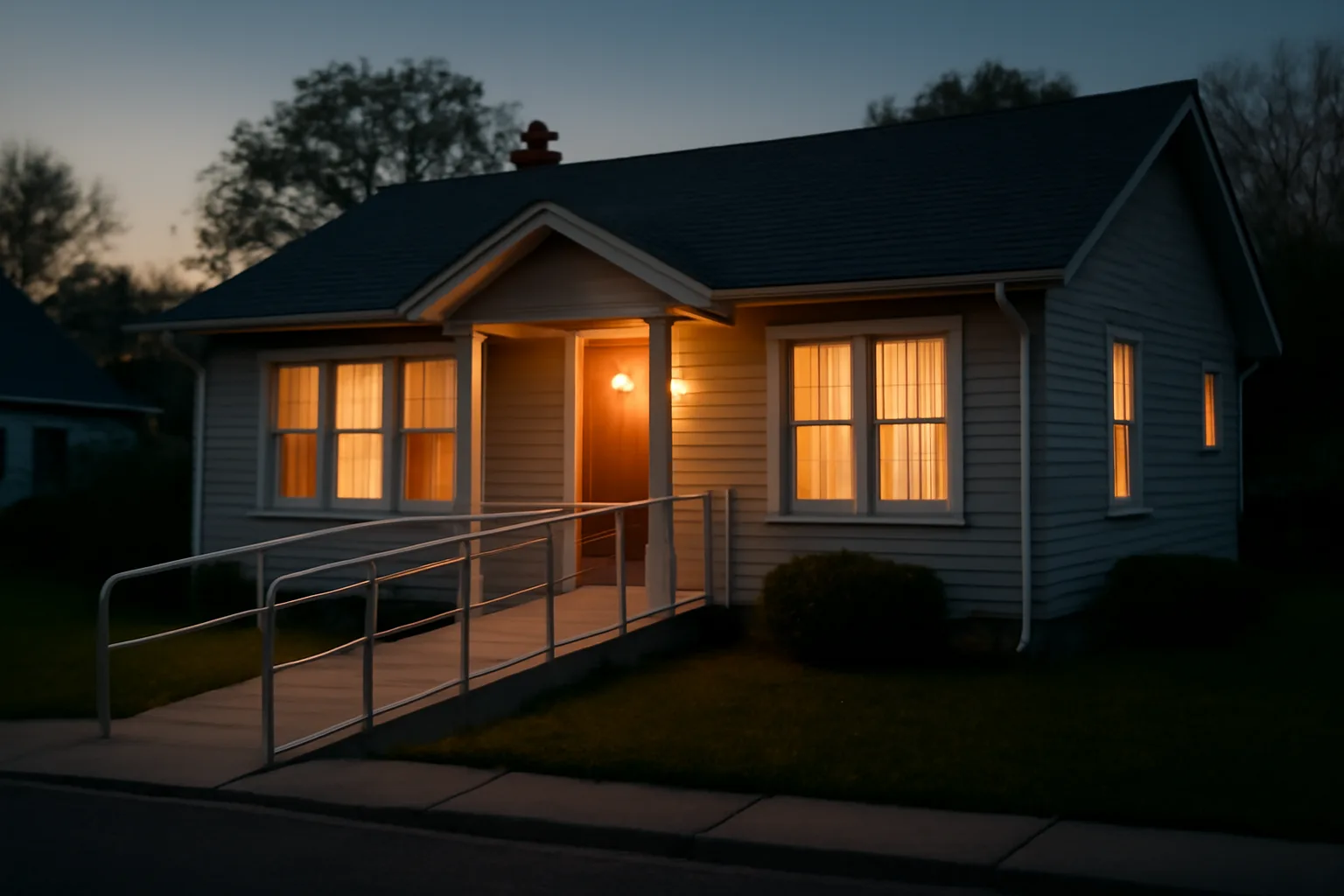
A group home is a residential property, usually a regular-looking house or small multi-unit building, where a licensed operator provides housing along with some level of supervision, personal care, or support services to a small number of residents. It's not a hospital and it's not an apartment complex with a leasing office. It sits in between: more support than independent living, less clinical than a nursing facility. The residents vary by state and license type. Some group homes serve adults with intellectual or developmental disabilities (IDD). Some serve people in mental health recovery or substance use recovery. Some are licensed as adult foster care or adult family homes for seniors who need help with daily activities but not skilled nursing. Each of these has its own license category, its own rules, and often its own state agency. What makes a group home "licensed" rather than just a shared house is the paper trail: an application filed with a state agency, a facility inspection, staff background checks (often through a state or FBI fingerprint system), a policy and procedures manual, and an ongoing inspection cycle. Operating one of these homes without the license required for the population you serve is a real legal problem in every state, not a technicality. Size matters too. Many states cap "small" group homes at somewhere around 4 to 8 residents before different fire code and staffing rules kick in, though the exact number depends on your state's definitions. Always confirm the resident cap and license category with your state licensing agency before you sign a lease or make an offer on a property.
What is assisted living?
Assisted living is a licensed residential care model for people, usually older adults, who need help with activities of daily living (bathing, dressing, medication reminders, mobility) but don't need the round-the-clock skilled nursing care a nursing home provides. It sits between independent senior living and a nursing facility on the care spectrum. The Centers for Medicare & Medicaid Services (CMS) doesn't run a federal assisted living license; licensing is entirely a state function, which is why the same building type is called "assisted living," "residential care facility," "personal care home," or "adult foster care" depending on which state you're in. Medicare.gov itself notes that "assisted living facilities are not certified by Medicare" [1], which is a big deal for anyone comparing costs (more on that below). Assisted living residents typically have their own room or apartment, take meals in a common dining area, and get staff support on a schedule rather than constant one-on-one care. Compare that to a small group home, which might have shared bedrooms and a more homelike, family-style staffing model. Both are licensed residential care, but assisted living usually implies a larger operation with more built-in amenities and a bigger staff. If you're researching this model specifically, our guide on assisted living and the companion piece on assisted living facilities break down licensing by state in more detail.
What is an assisted living facility?
An assisted living facility is the physical building and licensed operation where assisted living services happen, licensed by a state health or social services department under names that vary by state, such as "residential care facility for the elderly" (California), "assisted living residence" (many East Coast states), or "personal care home" (Pennsylvania, Georgia). The license type dictates the resident population, the staffing ratios, the building code standard, and the inspection frequency. Most states divide assisted living facilities into tiers based on the level of care offered. A basic tier might handle medication reminders and help with dressing. A higher tier (sometimes called "enhanced" or "limited nursing") might allow staff to manage more complex medical needs like tube feeding or wound care, usually with a nurse on staff or on call. Getting the tier wrong on your application, or trying to accept residents whose needs exceed your license tier, is one of the fastest ways to draw a citation during inspection. Building requirements typically include a minimum square footage per resident, an evacuation plan reviewed by the local fire marshal, and accessibility features under the Americans with Disabilities Act framework, depending on the state's building code adoption. None of this is optional; it's baked into the licensing application itself. Read our page on assisted living facility licensing basics if you're mapping out the building side of your project.
What is assisted living vs nursing home?
| Regulator | State licensing agency | State + federal (CMS certification) | |
|---|---|---|---|
| Medical staffing | Varies by state, often no RN required on-site | RN required 8+ hrs/day per federal rule [3] | |
| Typical resident need | Help with ADLs, medication reminders | Skilled nursing, rehab, hospital-level care | |
| Medicare coverage | Not covered [1] | Covered short-term after qualifying hospital stay [4] | |
| Medicaid coverage | Varies by state, often via HCBS waiver | Covered as a mandatory Medicaid benefit [2] | The practical upshot for anyone opening a residential care business: if your target residents need daily skilled nursing (wound vacs, IV therapy, ventilators), you are looking at a nursing facility license, a completely different and far more capital-intensive path than a group home or assisted living license. |
The core difference is medical intensity. Assisted living is for people who need help with daily tasks but not ongoing skilled nursing; a nursing home (skilled nursing facility) is for people who need daily medical care, rehabilitation, or 24-hour licensed nursing supervision. Medicaid.gov describes nursing facility services as covering people who "require a level of care equivalent to that received in a hospital" but who don't need to be hospitalized [2], which is a meaningfully higher bar than assisted living's help-with-daily-living model. Nursing homes are required to have a registered nurse on duty for at least 8 consecutive hours a day, 7 days a week, and licensed nursing staff (RN or LPN) around the clock, under federal nursing home requirements at 42 CFR 483.35 [3]. Assisted living has no equivalent federal staffing mandate because it isn't a Medicare or Medicaid-certified provider category at the federal level; staffing rules come entirely from the state license. Here's a side-by-side: | Feature | Assisted living | Nursing home (skilled nursing) |
What does assisted living provide?
Assisted living typically provides housing, meals, help with activities of daily living, medication management or reminders, housekeeping, laundry, social and recreational activities, and 24-hour staff availability for safety checks. What it does not typically provide, without an add-on license or waiver, is skilled nursing care. The specific service list is defined by each state's licensing regulations, and it usually maps to the license tier the facility holds. A basic-tier home might only offer medication reminders (staff hands the resident their pre-sorted pillbox) rather than medication administration (staff actually gives the medication), and that distinction alone often requires a different license or a certified med aide on staff. Meals are almost always required, typically three meals a day plus snacks, prepared to accommodate common dietary restrictions. Activities programming is required in most states too, though the specifics (a minimum number of hours per week, a written activity calendar) vary. If you're drafting a policy manual, this is the section inspectors read line by line, because it's where "what we say we do" gets checked against "what residents actually experience."
How to start a group home
Starting a licensed group home generally means five things happening roughly in this order: pick your license category and state agency, secure a compliant property, write your policy and procedures manual, hire and background-check staff, and pass a pre-licensing inspection. 1. Identify your license category. "Group home" isn't one license; it's a family of licenses (adult foster care, IDD residential, mental health residential, adult family home, RCFE/assisted living, etc.). Contact your state's licensing agency (usually under the department of health or department of human/social services) to confirm which category fits your target population, because the application forms and staffing rules differ by category. 2. Check zoning before you sign anything. Many group homes qualify for reasonable accommodation under the federal Fair Housing Act. The Fair Housing Act, at 42 U.S.C. 3604(f)(3)(B), makes it unlawful discrimination to refuse "reasonable accommodations in rules, policies, practices, or services" when necessary to give a person with a disability equal opportunity to use a dwelling [5]. That protection is real, but it doesn't erase local fire code, occupancy limits, or the need for a certificate of occupancy. Confirm zoning classification with your local planning department and your state licensing agency before committing to a lease. 3. Write the policy and procedures manual. Every state licensing application requires a written manual covering admissions criteria, medication management, emergency and evacuation procedures, resident rights, grievance procedures, staff training, and incident reporting. This document is usually reviewed before your first inspection, and gaps here are one of the most common reasons applications get sent back for revision. 4. Build your staffing plan. Staffing ratios (residents per staff member, awake-overnight requirements, minimum certifications like CPR/First Aid or a state-specific caregiver training course) are set by your state's regulations, not by you. Budget for background checks on every staff member, which most states run through a state repository and often the FBI, under state-specific mandatory background check statutes. Confirm the specific screening statute and disqualifying-offense list with your state licensing agency. 5. Schedule and pass the pre-licensing inspection. State surveyors typically check the physical building (fire alarms, sprinklers or smoke detectors, exits, accessible bathrooms), review resident files or sample charts, and interview staff about emergency procedures. Some states also require a separate fire marshal sign-off and a local health department food service inspection if you're preparing meals on-site. This is also the point where a lot of first-time operators realize how much of the paperwork overlaps across states, application checklists, sample policy language, staffing matrices, self-audit forms. That's the gap the $299 State Group Home Licensing Kit is built for: state-specific application checklists and policy templates so you're not starting the manual from a blank page. It doesn't replace your state's application or guarantee approval; no product legitimately can. Every state licensing agency makes the final licensing decision, and timelines and requirements differ by state and license type.
What is the difference between assisted living and nursing home?
The short answer: assisted living is non-medical residential care for people who need help with daily activities; a nursing home is medical, licensed skilled nursing care for people who need ongoing clinical treatment. This is worth repeating because the terms get used loosely in casual conversation but mean very different things on a license application. A resident who is largely independent but needs reminders and some help bathing or dressing fits assisted living. A resident recovering from a stroke who needs daily physical therapy, wound care, and a licensed nurse checking on them multiple times a day fits a nursing home. Some residents transition from assisted living to a nursing home as their needs increase, and some assisted living communities have a "memory care" or "enhanced" wing that bridges the gap, but that still requires a specific license add-on, more than a policy change. For an operator, the difference also means a completely different capital structure. Nursing homes require far more clinical staff, a medical director relationship, and CMS certification if you want to bill Medicare or Medicaid for skilled nursing days. Group homes and assisted living generally don't carry that federal certification layer at all; their funding runs through state Medicaid waiver programs, private pay, or in some cases SSI-linked state supplements.
Does Medicare cover assisted living facilities?
No. Medicare does not cover the cost of living in an assisted living facility, including room, board, and personal care services. Medicare.gov is direct about this: assisted living facilities "are not certified by Medicare" and Medicare does not pay for the custodial, non-medical care that assisted living primarily provides [1]. What Medicare will cover, even for someone living in assisted living, is medically necessary services delivered under Medicare Part A or Part B, things like doctor visits, physical therapy ordered by a doctor, durable medical equipment, or a short skilled nursing facility stay following a qualifying hospital stay of at least 3 days [4]. None of that pays the facility's monthly rate for room, board, or custodial care. Medicaid is a different story and much more relevant to group home funding. Many states use a Medicaid Home and Community-Based Services (HCBS) waiver, authorized under section 1915(c) of the Social Security Act, to help cover the cost of personal care in a residential setting, though room and board are typically excluded and paid separately by the resident through SSI or other income [6]. Coverage, waiver availability, and reimbursement rates vary enormously by state, so if your business model depends on Medicaid waiver residents, confirm the current waiver rules and rates with your state Medicaid agency before you build a budget around them.
How do I start a group home? (funding and Medicaid basics)
Funding a licensed group home usually comes from a mix of private pay, Medicaid waiver reimbursement, and sometimes state supplemental payments tied to Supplemental Security Income (SSI); there is no federal grant program that hands out startup money for opening a group home. For IDD and mental health group homes specifically, Medicaid HCBS waivers are the most common funding channel. The statute governing these waivers, section 1915(c) of the Social Security Act (42 U.S.C. 1396n(c)), allows the Secretary to waive Medicaid requirements so a state may provide home and community-based services to individuals who would otherwise need institutional care [7]. To bill Medicaid at all, your home typically needs its state license first, then a separate Medicaid provider enrollment and, in some cases, a waiver-specific certification with its own site visit. Because reimbursement rates, waiver caps, and waiting lists differ so much by state (some states have waiver waiting lists that run for years), it's worth talking to your state Medicaid agency and your state's IDD or aging services division before you finalize your business plan, not after you've signed a lease. A home that pencils out in one state's waiver rate environment can be underwater in another.
What does the group home licensing and inspection process actually look like?
Licensing follows a fairly consistent shape across states even though the forms differ: application submission, background checks, a facility plan review, a pre-licensing inspection, license issuance, and then a recurring inspection cycle (often annual, sometimes tied to complaints). Most states require the local fire authority to sign off separately from the state licensing surveyor, since fire and life-safety code enforcement is usually a local government function even when the license itself is a state license. Don't assume one inspection covers both; schedule them as separate steps. Once licensed, expect unannounced inspections, more than the renewal-cycle visit. Surveyors typically review resident records, medication logs, staff training files, and incident reports, and they interview residents and staff directly. A citation doesn't automatically mean license revocation; most states have a corrective action plan process first, with revocation reserved for serious or repeated violations. Still, plan your staffing and documentation as if an inspector could show up tomorrow, because in practice, one often can.
What ongoing rules do licensed group homes have to follow?
Beyond the initial license, operators are on the hook for continuing compliance: staff training renewals, incident and death reporting timelines, resident rights protections, medication management audits, and license renewal paperwork, usually annually or biennially depending on the state. Resident rights requirements typically include things like the right to privacy, the right to manage personal funds (or have them managed with an accounting), grievance procedures, and protection from retaliation for filing a complaint. These aren't boilerplate; state surveyors specifically check whether residents know these rights exist, often by asking residents directly during inspection. Incident reporting rules are usually strict on timing: many states require reporting of a resident death, serious injury, or abuse allegation to the licensing agency within a set number of hours, not days. Missing an incident reporting deadline is treated as a compliance failure on its own, separate from whatever the underlying incident was. Confirm your state's exact reporting windows and forms with your licensing agency, since these details change and vary by license type.
Frequently asked questions
What is assisted living?
Assisted living is a state-licensed residential care option for people, usually older adults, who need help with daily activities like bathing, dressing, or medication reminders but don't need full-time skilled nursing care. It includes housing, meals, and staff support, but Medicare does not cover it, per Medicare.gov guidance [1].
What is a group home?
A group home is a licensed residential setting, often a house, where a small number of residents live together and receive supervision or personal care from licensed staff. License types include adult foster care, IDD residential, mental health residential, and senior residential assisted living, each regulated separately by the state.
What is an assisted living facility?
An assisted living facility is the licensed building and operation providing assisted living services, regulated by a state agency under names like "residential care facility" or "personal care home" depending on the state. It's defined by its license tier, which sets the allowed level of care and staffing requirements.
What is the difference between assisted living and a nursing home?
Assisted living provides non-medical help with daily activities; a nursing home provides skilled, licensed nursing care for people needing hospital-level medical support. Federal rule 42 CFR 483.35 requires nursing homes to have licensed nursing staff around the clock [3]; assisted living has no equivalent federal staffing mandate.
Does Medicare cover assisted living facilities?
No. Medicare.gov states assisted living facilities are not certified by Medicare, so Medicare does not pay for room, board, or personal care there [1]. Medicare can still cover medically necessary services like doctor visits or therapy for someone who happens to live in assisted living.
How do I start a group home?
Pick your license category with your state licensing agency, confirm zoning and building code compliance, write a policy and procedures manual, build a compliant staffing plan with background-checked staff, and pass a pre-licensing inspection covering fire safety and resident care standards. Requirements and timelines vary significantly by state.
Does Medicaid pay for group homes?
Often yes, through state Medicaid Home and Community-Based Services (HCBS) waivers authorized under Social Security Act section 1915(c), though room and board are usually excluded and paid separately by the resident [6][7]. Coverage and reimbursement rates vary by state, so confirm current rules with your state Medicaid agency.
How many residents can a licensed group home have?
It depends entirely on your state's license category. Many states set a "small" group home cap somewhere around 4 to 8 residents before stricter fire code and staffing rules apply, but the exact number and the definition of small versus large facility varies by state. Confirm the cap with your state licensing agency.
Is a group home the same as assisted living?
Not exactly. Both are licensed residential care, but assisted living usually implies a larger operation with private or semi-private apartments and scheduled staff support, while a group home is often smaller and more homelike, sometimes with shared bedrooms. License categories and terminology differ by state.
What staff qualifications are required in a licensed group home?
Requirements vary by state and license type but commonly include a criminal background check (state and often FBI), CPR/First Aid certification, and a state-approved caregiver or direct support training course completed within a set number of days of hire. Confirm exact requirements with your state licensing agency.
Can a group home operate without a state license?
No. Providing supervision or personal care to residents in a residential setting without the required state license is a legal violation in every state, regardless of how small the operation is. The specific licensing statute and penalties vary by state; confirm requirements with your state licensing agency before accepting any residents.
What's the difference between medication reminders and medication administration in a group home?
A medication reminder means staff prompts the resident to take medication they self-administer, while medication administration means staff actually gives the medication, often requiring a certified medication aide or nurse. Which one your license allows depends on your license tier; offering administration without the right certification is a common inspection citation.
Sources
- Medicare.gov, Long-term care coverage guidance: Assisted living facilities are not certified by Medicare and Medicare does not cover the cost of living there
- Medicaid.gov, Nursing Facilities: Nursing facility services cover people requiring a level of care equivalent to hospital care
- eCFR, 42 CFR 483.35 Nursing Services: Federal nursing home rule requiring licensed nursing staff availability including at least 8 consecutive hours of RN coverage daily
- Medicare.gov, Skilled Nursing Facility Care: Medicare covers short-term skilled nursing facility care after a qualifying hospital stay of at least 3 days
- Fair Housing Act, 42 U.S.C. 3604(f)(3)(B): Refusal to make reasonable accommodations in rules, policies, practices, or services necessary to give a person with a disability equal opportunity to use a dwelling is unlawful discrimination
- Medicaid.gov, Home & Community-Based Services 1915(c): Medicaid 1915(c) waivers help fund home and community-based services as an alternative to institutional care
- Social Security Act section 1915(c), 42 U.S.C. 1396n(c): Section 1915(c) allows the Secretary to waive Medicaid requirements so a state may provide home and community-based services as an alternative to institutional care