Last updated 2026-07-25
TL;DR
Mustang Creek Estates is a multi-state residential assisted living brand operating small, home-like memory care and assisted living residences. This article uses it as a jumping-off point to explain what assisted living actually is, how it differs from a nursing home or group home, and what it takes to license a residential care home yourself.
What is Mustang Creek Estates and what kind of care does it offer?
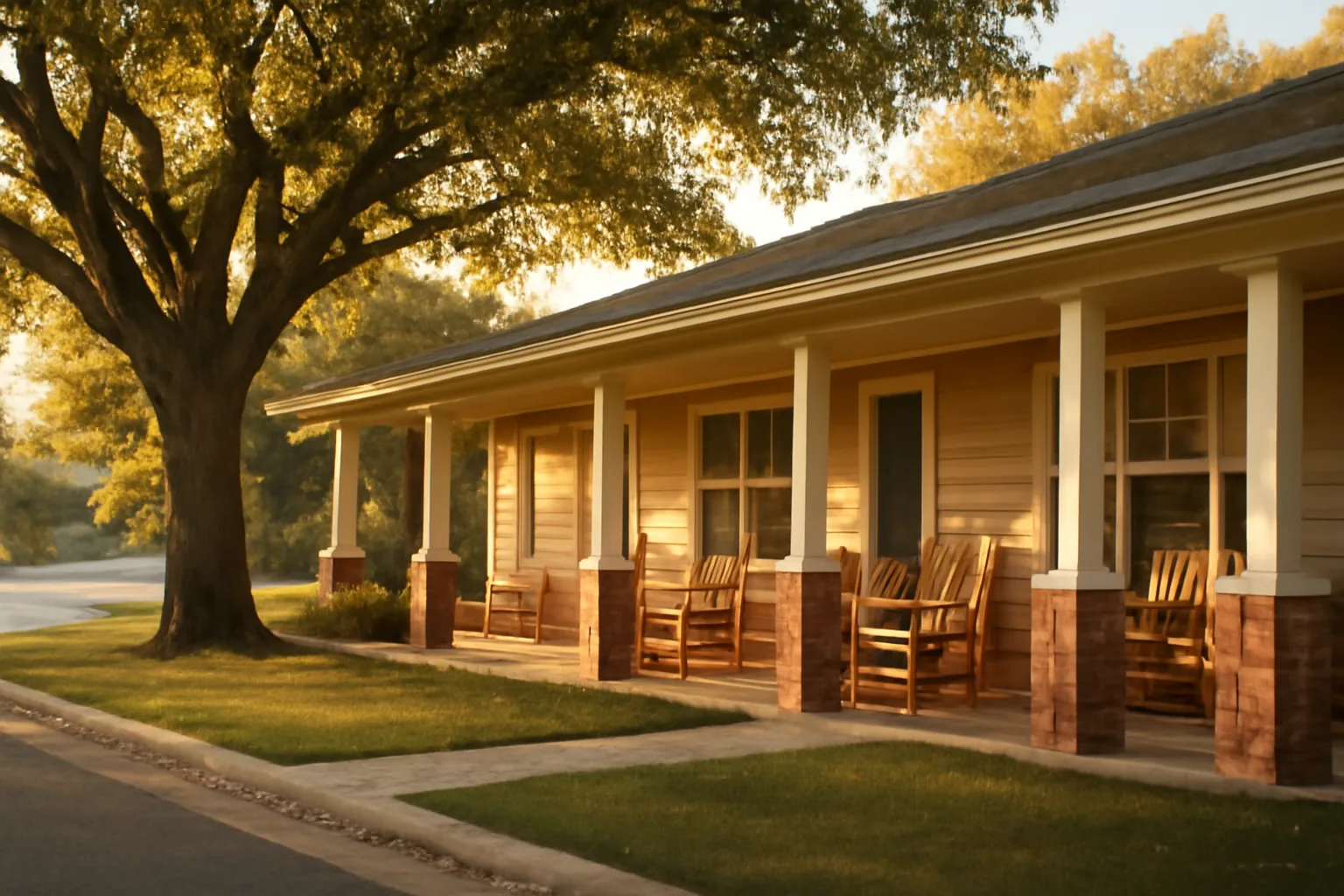
Mustang Creek Estates is a residential assisted living and memory care company that operates small, ranch-style residences in several states, including Texas, Oklahoma, and Kansas. The model leans on smaller resident counts per home compared to a big institutional building, with the idea that a lower staff-to-resident ratio and a house-like layout suit people with dementia and general aging-related care needs better than a 120-bed facility with long hallways. This article isn't a corporate directory entry. We're using the Mustang Creek Estates name because a lot of people search it while trying to understand the residential assisted living category itself, more than one company. If you're comparing care options for a family member, or you're an operator scoping out whether to build something similar, the real question underneath the search is: what is residential assisted living, how does it differ from a nursing home, and what does it take to open one. We'll answer both. First the consumer-facing questions (what assisted living is, how it differs from a nursing home, what Medicare covers), then the operator-facing ones (how to start a group home, what licensing actually involves).
What is assisted living?
Assisted living is a licensed residential care setting for adults, usually seniors, who need help with daily activities like bathing, dressing, medication reminders, and meals, but who don't need the round-the-clock skilled nursing care that a nursing home provides. Residents typically live in private or semi-private rooms or apartments and have access to staff on site. The federal government does not license or directly regulate assisted living. Each state writes its own rules, and the terminology varies: some states call it "assisted living facility," others use "residential care facility," "personal care home," "adult care home," or "community-based residential facility." Because there's no single federal definition, coverage of services, staffing ratios, and even the physical size of a legal assisted living home can differ enormously from Ohio to Texas to Oregon. The National Center for Health Statistics, in its most recent Long-Term Care Providers survey data, counted roughly 30,600 residential care communities operating in the United States, serving close to 1,000,000 residents [1]. That figure includes everything from converted single-family homes with six beds to large purpose-built campuses with 150 units, because the category is defined by function (non-medical personal care in a residential setting) rather than by size.
What is a group home?
A group home is a small residential setting, usually a single-family style house, where a limited number of unrelated residents live together and receive support services, supervision, or care from paid staff. The term is used across several different populations: adults with intellectual and developmental disabilities (IDD), people in mental health recovery, adults in substance use recovery, and increasingly, seniors who need lower-level personal care. Group homes and residential assisted living homes overlap conceptually (small, home-like, staffed) but the licensing category and the population served usually determine which set of state rules apply. A group home for adults with IDD is typically licensed under a state's developmental disabilities agency, while a residential assisted living home serving seniors falls under the state's aging or health department. Mustang Creek Estates' residences fall into the assisted living / memory care licensing category, not the IDD group home category, even though the physical building style (a house, not an institution) looks similar. If you're trying to figure out which category your planned home falls under, start with your state's licensing agency directory rather than guessing from the marketing language competitors use, since the same word ("residential care home," for example) can mean different things depending on the state.
What is an assisted living facility, exactly?
An assisted living facility is the licensed building and program combined: a physical residence plus a set of state-approved services, staffing, and record-keeping that together earn it a license to operate as assisted living. The facility license is what allows a home to legally advertise itself as "assisted living," admit residents who need personal care, and bill for that care. Most states set minimum requirements around: resident room size and private bath access, staff awake and on-site 24 hours a day, a written service plan for each resident, medication management procedures, and a fire/life safety inspection. For example, Texas requires assisted living facilities to be licensed by the Texas Health and Human Services Commission and to maintain specific staffing and physical plant standards under Texas Administrative Code Title 26, Chapter 553 [2]. California licenses these homes as Residential Care Facilities for the Elderly (RCFEs) through the Department of Social Services, Community Care Licensing Division [3]. The words "assisted living facility" and "residential care facility" are often used interchangeably in casual conversation, but the actual legal term you need to use on your application is whatever your specific state calls it. Search your state's licensing agency site for the exact program name before you draft anything, because using the wrong term on paperwork slows down review.
What is the difference between assisted living and a nursing home?
| Regulator | State licensing agency | State + federal (CMS) | |
|---|---|---|---|
| Medical staff required | Varies by state, often none required on-site 24/7 | RN required 8 hrs/day minimum [4] | |
| Typical resident need | Help with ADLs, supervision | Skilled nursing, rehab, complex medical needs | |
| Medicare coverage | Does not cover room and board | Covers short-term skilled stays under conditions | |
| Setting | Home-like, private rooms/apartments | Institutional, often shared rooms | A resident might start in assisted living and later need to move to a nursing home if their medical needs exceed what the assisted living license permits them to provide. Most states cap what assisted living staff can legally do medically (for example, many restrict administering injections or managing complex wound care), and exceeding that scope is a common finding in state inspections. |
Assisted living provides help with daily living activities and some health monitoring in a residential setting, while a nursing home (also called a skilled nursing facility) provides 24-hour medical and nursing care for people with more serious health conditions or recovery needs. The core difference is the level of medical care and the license type, more than the building's appearance. Nursing homes are certified under federal Medicare and Medicaid rules (42 CFR Part 483) and must have a registered nurse on duty for at least 8 consecutive hours a day, seven days a week, per federal requirements enforced by the Centers for Medicare & Medicaid Services [4]. Assisted living facilities are not federally certified at all; they're licensed purely at the state level, and staffing requirements (often a "qualified" staff member awake and on-site, not necessarily a nurse) are set state by state. Here's a side-by-side that captures the practical differences: | Feature | Assisted Living | Nursing Home |
What does assisted living provide, day to day?
Assisted living typically provides: meals, housekeeping, laundry, transportation to appointments, help with bathing/dressing/toileting, medication reminders or administration (depending on state rules), social and recreational activities, and 24-hour staff availability for safety supervision. It does not typically provide ongoing skilled nursing, IV therapy, or ventilator care, though some states have a higher-tier license (often called "enhanced" or "assisted living plus") for residents with slightly more complex needs. Most facilities create an individual service plan for each resident within the first days of admission, listing exactly what help that person needs and how often. State inspectors check these plans against actual observed care during surveys, so a mismatch (plan says "assist with bathing daily," staff logs show it happening twice a week) is a common citation. Memory care, which Mustang Creek Estates specifically markets, is a specialized version of assisted living for residents with Alzheimer's or other dementias. States often require additional staff training hours, secured exits, and specific programming for memory care units, layered on top of the base assisted living license. If you're researching options for a family member and comparing facilities, it's worth checking assisted living facilities near you against the specific memory care add-on licensure, more than the general assisted living license, since not every assisted living home is licensed or staffed for dementia care.
Does Medicare cover assisted living facilities?
No. Medicare does not cover the cost of room and board in an assisted living facility, and it does not pay for personal care services like help with bathing or dressing in that setting. Medicare.gov states plainly that Medicare "doesn't cover long-term care (also called custodial care)" for daily activities, which is the category assisted living falls into [5]. Medicare will cover medically necessary services a resident receives, like doctor visits, physical therapy, or durable medical equipment, even while they live in assisted living, but it won't pay the facility itself for housing or personal care. This is one of the most common points of confusion for families starting the search, and it catches people off guard because Medicare does cover short-term skilled nursing facility stays after a qualifying hospital stay, under specific conditions (42 CFR 409.30) [6]. Medicaid is different. Most states offer a Medicaid waiver, often called an HCBS (Home and Community-Based Services) waiver, that can help cover personal care and some services within assisted living, though it typically does not cover room and board either. Medicaid.gov describes these waivers as allowing states to "furnish an array of home and community-based services that assist beneficiaries to live in the community" instead of an institution [7]. Coverage, income limits, and waiting lists vary widely by state, so anyone counting on Medicaid to help pay needs to check their specific state Medicaid agency's waiver program directly, not assume nationwide rules apply.
How to start a group home: what's actually involved?
Starting a group home or residential assisted living home involves five broad phases: choosing your population and license type, securing a property that meets zoning and building code requirements, completing your state licensing application and background checks, writing your policy and procedure manuals, and passing a pre-licensing inspection. There's no shortcut around any of these; every state requires all five in some form. Step one is deciding exactly who you'll serve, because that decision determines which state agency you apply to and which rulebook governs you. A home for seniors needing personal care goes through the aging/health licensing division (as Mustang Creek Estates-style homes do). A home for adults with IDD goes through the developmental disabilities agency. A home for mental health or substance recovery often falls under behavioral health licensing. Mixing populations in one home without the right license type is a fast way to get an application rejected or, worse, get cited after opening. Step two is the property. Most states require a certain minimum square footage per resident bedroom (commonly in the 80 to 100 square foot range for a single room, though this varies by state, so confirm with your state licensing agency), a working fire sprinkler or alarm system meeting local fire code, ADA-compliant common areas in many cases, and zoning approval for a "residential care" or "group home" use in that specific parcel. Zoning is where a lot of first-time operators get stuck: a house zoned single-family residential may or may not allow a licensed care home depending on your municipality's code and how many residents you plan to serve. Check with your city or county zoning office before you sign a lease or purchase agreement, not after. Step three is the license application itself: background checks (often FBI fingerprint-based) for the administrator and all staff, proof of financial solvency, a fire marshal inspection, a health department inspection, and often a specific administrator training or certification requirement (some states require a licensed administrator course of a set number of hours). Step four is your policy manual: admission and discharge policies, medication management procedures, emergency and disaster plans, resident rights disclosures, staffing schedules, and incident reporting procedures. Step five is the actual pre-licensing survey, where a state inspector walks the property and reviews your paperwork before issuing the license. This is the process where starting a group home research tends to blow up timelines for first-time operators, mostly because people underestimate how long the property and zoning steps take relative to the paperwork steps.
How do I start a group home step by step, state by state?
Because licensing is entirely state-controlled, the exact steps differ by state, but the sequence is broadly consistent: contact your state licensing agency first, before you sign a lease. Ask directly what license category applies to your planned population and get the current application packet and fee schedule in writing, since agencies update fees and forms periodically. A reasonable general sequence looks like this: 1. Identify your population and confirm the correct license category with your state agency. 2. Confirm zoning for the specific property with your city or county planning department. 3. Submit the license application, including background checks and any required administrator certification. 4. Complete required staff training (many states mandate specific hours in first aid, CPR, medication administration, and abuse reporting before opening). 5. Write and finalize your policy and procedure manual, covering admissions, care planning, medication management, emergencies, grievances, and staffing. 6. Pass the fire marshal and health/licensing inspection. 7. Receive your provisional or full license and open. The paperwork volume surprises almost everyone the first time through. Building all of this from scratch, state by state, is exactly the gap the $299 State Group Home Licensing Kit is built to close: state-specific application checklists and policy manual templates so you're not starting from a blank page for admissions policy, medication management procedure, or emergency plans. It doesn't replace talking to your state licensing agency directly, and it doesn't guarantee approval (no product legitimately can), but it saves the hours most operators spend just figuring out what documents they're even supposed to produce.
How does staffing work in a residential assisted living home like Mustang Creek Estates?
Staffing in residential assisted living centers on having a trained, awake staff member on-site at all times, with the specific ratio of staff to residents set by each state, not federal law. Smaller residential-style homes (6 to 16 beds, which is roughly the range many Mustang Creek Estates-style operators build in) typically run with 1 to 2 direct care staff per shift plus a rotating administrator or med-tech role, though exact minimums vary by state and by shift (day shifts generally require more staff than overnight). Most states require a designated administrator who holds a specific license or completed a state-approved training course, plus ongoing annual training hours for direct care staff in topics like medication administration, abuse/neglect reporting, CPR/first aid, and dementia care if the home serves memory care residents. Some states also cap the number of residents one direct care worker can supervise at a time, particularly overnight. Staffing plans get reviewed as part of the license application and again at every renewal inspection, so a written staffing schedule that matches your actual timeclock records matters more than people expect. Inspectors commonly flag facilities where the posted schedule doesn't match payroll or sign-in sheets.
What should a family ask when comparing homes like Mustang Creek Estates to other options?
Families comparing a residential assisted living brand to other local options should ask about license status and any recent inspection findings, staff-to-resident ratio on the shift their loved one would actually experience (more than the daytime average), what level of medical need triggers a required move-out, and how the facility handles a resident's decline in condition over time. Every state licensing agency maintains a public database of licensed facilities, and most publish recent inspection reports online. This is the single most useful free tool available: look up the actual survey history for any specific home you're considering, whether it's a Mustang Creek Estates location or a smaller independent operator, before you tour it. A facility with a pattern of repeat citations for medication errors or staffing shortfalls is telling you something a glossy brochure won't. Also ask what happens financially and logistically if a resident needs to transition to a nursing home level of care. Some assisted living communities have an affiliated skilled nursing option; many don't, and families end up doing a stressful search for a new placement during a health crisis if they haven't asked this question up front.
Frequently asked questions
What is assisted living in simple terms?
Assisted living is a licensed residential setting where seniors or adults needing help with daily tasks like bathing, dressing, and medication reminders live in private or shared rooms with staff available around the clock. It's not a hospital or nursing home; it's a home-like environment with built-in support, licensed and regulated at the state level rather than federally.
What is the difference between assisted living and a nursing home?
Assisted living helps with daily living activities in a residential setting and is licensed only at the state level. A nursing home provides 24-hour skilled medical care, is certified under federal Medicare/Medicaid rules, and must staff a registered nurse at least 8 hours a day per federal requirement (42 CFR 483) [4].
Does Medicare cover assisted living facilities?
No. Medicare does not pay for room, board, or personal care in assisted living because it classifies that as custodial long-term care, which it explicitly excludes from coverage, per Medicare.gov [5]. Medicare will still pay for medically necessary services like doctor visits or therapy a resident receives while living there.
How do I start a group home?
Start by contacting your state's licensing agency to confirm which license category fits your planned population (seniors, IDD, mental health, or recovery), then check zoning for your property, complete the license application with background checks, build your policy manual, train staff, and pass a pre-licensing inspection. The exact steps and fees differ by state.
What is a group home, and how is it different from an assisted living facility?
A group home is a small residential setting where unrelated residents receive support from paid staff; it's a broad term used across IDD, mental health, recovery, and senior populations. An assisted living facility is a specific licensed category, usually for seniors needing personal care, under a state's aging or health department rules.
What does assisted living provide that home care doesn't?
Assisted living provides 24-hour on-site staff availability, meals, housekeeping, social activities, and a structured service plan, all within one location. In-home care provides similar personal care help but only during scheduled visit hours, without the built-in social environment or overnight staff presence that assisted living includes.
Is Mustang Creek Estates a nursing home or assisted living?
Mustang Creek Estates operates as residential assisted living and memory care, not a nursing home. That means it's licensed at the state level for personal care and supervision, not federally certified for skilled nursing, and it doesn't provide the 24-hour registered nurse coverage that a nursing home is required to have.
How much does it cost to license a group home?
License application fees vary significantly by state and by facility size, often ranging from under $100 to several thousand dollars depending on bed count and license type. Confirm the exact fee schedule with your state licensing agency, since amounts change and differ for initial applications versus renewals.
What's the minimum bed count for a residential assisted living home?
There's no federal minimum; states set their own thresholds, and some distinguish between small "residential care home" licenses (often 6 to 16 beds) and larger assisted living facility licenses with no practical upper limit. Confirm the specific bed-count categories and their different rule sets with your state licensing agency before choosing a property size.
Can an assisted living facility keep a resident who needs nursing home level care?
Generally no. State assisted living regulations typically define a "negotiated risk" or discharge criteria specifying when a resident's medical needs exceed what the facility is licensed to provide, requiring transfer to a skilled nursing facility. The specific triggers (like ventilator dependence or stage 3+ pressure ulcers) vary by state rule.
Does Medicaid pay for assisted living?
Medicaid doesn't typically cover room and board in assisted living, but many states offer Home and Community-Based Services (HCBS) waivers that can cover personal care services delivered within assisted living settings, per Medicaid.gov [7]. Availability, income eligibility, and waiting lists differ by state, so check your state Medicaid agency directly.
What inspections does an assisted living facility go through?
Assisted living facilities typically undergo a pre-licensing inspection before opening, then periodic renewal inspections (often annual or biennial depending on the state), plus fire marshal and health department reviews. Complaint-triggered inspections can also happen anytime a resident, family member, or staff files a report with the state licensing agency.
Sources
- CDC National Center for Health Statistics, Long-Term Care Providers and Services Users report: Approximately 30,600 residential care communities served nearly 1 million residents in the U.S.
- Texas Administrative Code, Title 26, Chapter 553 (Licensing Standards for Assisted Living Facilities): Texas licenses and regulates assisted living facilities under Title 26, Chapter 553 through HHSC
- California Department of Social Services, Community Care Licensing Division, RCFE program: California licenses assisted living homes as Residential Care Facilities for the Elderly (RCFEs)
- Code of Federal Regulations, 42 CFR Part 483, Subpart B (Requirements for Long Term Care Facilities): Nursing homes must be federally certified and have a registered nurse on duty at least 8 consecutive hours a day
- Medicare.gov, Long-term care coverage page: Medicare does not cover long-term custodial care such as room, board, and personal care in assisted living
- Code of Federal Regulations, 42 CFR 409.30 (Skilled nursing facility level of care): Medicare covers short-term skilled nursing facility stays under specific qualifying conditions
- Medicaid.gov, Home & Community-Based Services page: Medicaid HCBS waivers can help fund personal care services in community and residential settings instead of institutions