Last updated 2026-07-25
TL;DR
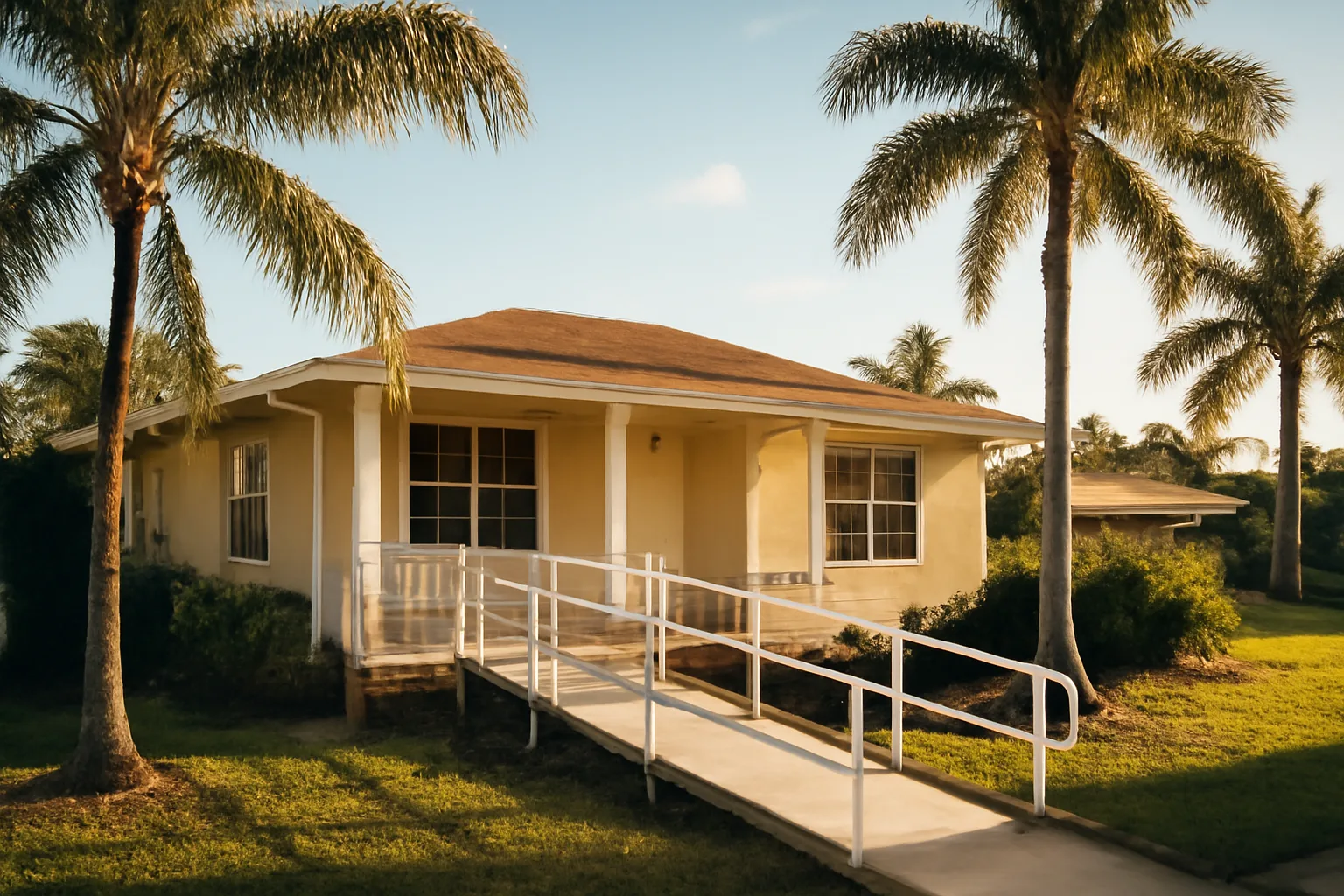
Residential assisted living in Largo, Florida means a small home-based facility licensed by the state as an Assisted Living Facility (ALF) under Florida Statutes Chapter 429, plus Pinellas County zoning and fire clearance. It is not a nursing home and Medicare does not pay for the room-and-board portion of care.
what is assisted living
Assisted living is a category of long-term care that helps people with daily tasks like bathing, dressing, medication reminders, and mobility, while letting them live in a home-like setting instead of a hospital or nursing facility. It sits between fully independent living and skilled nursing care. In Florida, the legal term is Assisted Living Facility, or ALF, and it is defined and regulated under Florida Statutes Chapter 429, Part I [1]. The statute describes an ALF as a facility that provides "housing, meals, and one or more personal services for a period exceeding 24 hours" to people who need help with activities of daily living [1]. When people search "residential assisted living Largo," they usually mean one of two things: a small, home-based ALF operating out of a single-family residence in a Largo neighborhood, or a larger licensed facility somewhere in Pinellas County. Both fall under the same state licensing law, though the size and layout change some of the operational and zoning details. If you're comparing this model to other levels of care, our overview of assisted living walks through the basic definitions state by state.
what is a group home
A group home is a residential setting where a small number of unrelated people live together and receive some level of support or supervision, often because of age, disability, mental illness, or recovery needs. The term is used loosely across the industry, and it overlaps with several different state license types. In Florida specifically, a group home for adults with intellectual or developmental disabilities is usually licensed by the Agency for Persons with Disabilities (APD) under a different set of rules than an ALF. A home for seniors needing help with daily living, meanwhile, is licensed as an ALF by the Agency for Health Care Administration (AHCA) [1]. Mental health and substance use recovery residences may fall under yet another set of standards, sometimes voluntary certification rather than state licensure. So the first real step in this business isn't picking a location. It's figuring out which population you intend to serve, because that answer determines which state agency you apply to, which statute governs your operation, and which staffing ratios apply. Get that wrong and you'll be filling out the wrong forms for months. For a broader look at the different resident groups this industry serves, see assisted living facility.
what is an assisted living facility
An assisted living facility is a licensed residential property, ranging from a converted single-family home with six beds to a purpose-built community with 100+ units, where operators provide housing plus personal care services under state oversight. In Florida, ALFs are licensed and inspected by AHCA under Chapter 429 and the corresponding administrative rules in Florida Administrative Code 58A-5 [2]. ALFs in Florida are further broken into license types depending on the level of care offered: standard, limited nursing services, extended congregate care, and limited mental health, among others [2]. A small residential home in Largo offering only help with daily activities and medication supervision typically operates under the standard license. If a home wants to keep residents who need nursing-level care, or serve people with a mental health diagnosis requiring specialized staff training, it needs the corresponding add-on designation, and that means more staff training hours and different inspection checklists. Florida law caps what basic ALFs can do medically. A standard license does not allow staff to perform skilled nursing tasks like wound care or tube feeding on an ongoing basis, that requires the limited nursing services designation or a higher license category [2]. Operators sometimes assume they can "just hire a nurse" and expand services informally. AHCA surveyors check for this specifically during inspections and it's a common citation.
what is assisted living facility (the licensing basics)
The practical version of "what is assisted living facility" licensing in Florida looks like this: you need a business entity, a physical location that passes fire and life safety inspection, an administrator who holds a state-approved Core license through AHCA-approved coursework, and a completed application packet submitted to AHCA's Long Term Care unit [1] [2]. AHCA requires initial licensure applicants to complete a background screening through the agency's clearinghouse for every owner, administrator, and staff member with resident contact [3]. That process alone can take several weeks, and it has to happen before you can open, not after. Expect a site survey before your license is issued. AHCA inspectors check physical plant requirements (room sizes, bathroom ratios, emergency lighting), staffing plans, resident record systems, and medication management procedures. Pinellas County and the City of Largo add their own layer: a certificate of occupancy for the intended use, local fire marshal sign-off, and, depending on your ALF's location and size, a zoning determination confirming residential care use is permitted in that district. Always confirm current zoning categories and any special exception process with the Largo Planning & Zoning division and Pinellas County directly, since these classifications and any conditional use requirements can change. For a state-by-state comparison of how this process differs outside Florida, our guide to assisted living facilities breaks down the agency names and general application flow in other states.
what is assisted living vs nursing home
| Licensing law (FL) | Chapter 429, Part I [1] | Different chapter, separate CMS survey process |
|---|---|---|
| Medical acuity | Help with ADLs, limited nursing add-on possible | Skilled nursing, rehab, higher acuity |
| Staffing | Awake staff sufficient for needs; RN only with add-on license | Licensed nurse coverage required around the clock |
| Setting | Home-like, private or semi-private rooms | Institutional, hospital-adjacent feel |
| Typical payer | Private pay, long-term care insurance, some Medicaid waivers | Medicare (short-term), Medicaid, private pay |
Assisted living and nursing homes are licensed under completely different statutory frameworks and serve people with different care needs, even though the public sometimes uses the terms interchangeably. Assisted living is for people who need help with daily activities but not around-the-clock medical or skilled nursing care. Nursing homes, in Florida licensed under a separate chapter and inspected on a different survey cycle, are for people who need ongoing skilled nursing, rehabilitation, or higher-acuity medical management [1]. Staffing is the clearest practical difference. Nursing homes must have licensed nurses on-site around the clock. Florida ALFs must have staff "awake and on duty" at all times sufficient to meet resident needs, but there is no blanket requirement for a registered nurse on every shift unless the facility holds a limited nursing services license [2]. Cost structure differs too: ALFs typically charge for room, board, and a tiered care package, while nursing home costs are usually bundled with medical services and billed differently to insurers. Here's a side-by-side snapshot: | Feature | Assisted Living Facility | Nursing Home |
what does assisted living provide
Assisted living provides housing plus a defined package of personal care and supportive services, and the exact list is spelled out in state rule rather than left to operator discretion. Under Florida's ALF rule, covered services generally include help with bathing, dressing, grooming, and mobility; medication management or supervision; three meals a day plus snacks; housekeeping and laundry; and social or recreational activities [2]. What it does not automatically provide is skilled medical treatment. If a resident needs regular injections, wound care, or IV therapy, the facility needs the limited nursing services license, or the resident needs to arrange outside home health care to supplement (which is legal and common) [2]. Medication management deserves its own callout because it's the single most common area cited during Florida ALF inspections. Staff assisting with medications must complete state-approved training, and unlicensed staff generally can't administer medications, only assist with self-administration, unless a nurse is involved under specific delegation rules [2]. If you're building your policy manual, this is the section to get airtight before your first survey, not after a deficiency notice.
how to start a group home
Starting a group home or ALF is a sequence, not a single application, and skipping steps out of order is the most common reason operators stall out for months. Here's the realistic order: 1. Decide your population (seniors needing ADL help, IDD, mental health, recovery) and confirm which state agency licenses that population in your state. 2. Form your business entity and get your EIN. 3. Find a property that either already has appropriate zoning for residential care or can realistically get a zoning approval or special exception. Do this before you sign a lease or close on a purchase; zoning is the step that kills the most projects. 4. Complete administrator training (in Florida, the AHCA-approved Core training course) [3]. 5. Draft your policy and procedure manuals: admission criteria, medication management, emergency preparedness, staffing plan, grievance procedures. 6. Submit background screening for all owners and staff through the state's clearinghouse [3]. 7. Pass fire marshal and building inspections. 8. Submit the state license application with all required attachments and pay the licensing fee (confirm current fee amounts with your state licensing agency, since these are adjusted periodically). 9. Pass the pre-licensure survey. 10. Get your license, then prepare for your first annual survey cycle. A lot of first-time operators build the physical space first and figure out licensing later. That's backwards. Confirm zoning and get a preliminary read from your state licensing agency before you spend money on renovations, because a home that looks perfect but sits in the wrong zoning district is a dead project. For help organizing this sequence into an actual checklist, the $299 State Group Home Licensing Kit at /licensing-kit-builder bundles state-specific application checklists and policy manual templates so you're not reverse-engineering the requirements from scratch.
what is the difference between assisted living and nursing home (cost and payer angle)
Beyond care level, the biggest practical difference between assisted living and a nursing home is who pays and how. Nursing home stays are frequently covered short-term by Medicare Part A after a qualifying hospital stay, subject to specific day limits and coinsurance [4]. Assisted living is different: Medicare does not cover the custodial room-and-board and personal care costs of assisted living at all [5]. Medicaid coverage also splits differently. Many states, including Florida, cover some assisted living services through a Medicaid waiver program (in Florida, this runs through the Statewide Medicaid Managed Care Long-Term Care program), but the waiver typically covers the care component, not room and board, and there are enrollment caps and waiting lists . Nursing home care, by contrast, is a mandatory Medicaid benefit under federal law once a resident is financially and medically eligible . So when a family in Largo asks whether Medicaid or Medicare will pay for mom's assisted living stay, the honest answer is: Medicare generally will not, and Medicaid coverage depends on waiver enrollment and slot availability, not automatic eligibility.
does medicare cover assisted living facilities
No. Medicare does not cover the cost of assisted living facility room and board or custodial personal care services. The Centers for Medicare & Medicaid Services is explicit about this: Medicare Part A and Part B cover medically necessary skilled care, and CMS guidance states that "Medicare doesn't cover room and board when you get hospice care in your home or another facility where you live (like a nursing home)" and generally excludes long-term custodial care from coverage [5]. Medicare will pay for specific medical services a resident receives while living in an ALF, things like physician visits, physical therapy ordered by a doctor, or home health visits, if those services independently meet Medicare's coverage criteria. But the facility's monthly rate for housing, meals, and personal care assistance is a private-pay or Medicaid-waiver cost, not a Medicare benefit [5]. This is one of the most common points of confusion for families researching options, and it's worth stating plainly to prospective residents and their families during the admission process so nobody signs a lease expecting a Medicare check to cover it.
how do i start a group home (funding and Medicaid angle)
If you're asking how to start a group home with an eye toward what funding sources residents will use, the answer depends heavily on which population you serve and which state program applies. For senior ALFs in Florida, the relevant Medicaid pathway is the Statewide Medicaid Managed Care Long-Term Care (SMMC LTC) program, administered by the Agency for Health Care Administration in coordination with the Department of Elder Affairs . Enrollment isn't automatic. There's a waitlist system, and providers need a Medicaid provider agreement to accept SMMC LTC clients. For IDD group homes, Florida's Agency for Persons with Disabilities manages its own Medicaid waiver (the iBudget Florida waiver), which is a separate application and licensing track entirely from ALF licensure. Don't build your financial model assuming full Medicaid waiver enrollment from day one. Waitlists in Florida's iBudget and SMMC LTC programs have historically run into the thousands of applicants depending on region and budget year , and getting a provider agreement approved takes its own separate timeline from your facility license. Most successful small operators start with a private-pay resident base and add Medicaid waiver contracts once they have a licensing and inspection track record.
how does zoning affect residential assisted living in Largo specifically
Zoning is where a lot of Largo-area projects run into their first real wall, because Florida's ALF statute doesn't override local land use law. Pinellas County and the City of Largo each maintain their own zoning codes, and residential care uses are typically permitted outright in some residential zones, allowed as a conditional or special exception use in others, and prohibited in some commercial or industrial zones without a variance. Before you lease or buy a property, contact the City of Largo's Planning & Community Development staff directly, and separately confirm your intended license type and expected resident count with AHCA, since bed count sometimes triggers different local zoning treatment (a 6-bed home is often treated more like a single-family residential use, while larger facilities may need site plan review). Always confirm current classifications directly with the city or county, since local zoning maps and ordinances change and this article cannot substitute for that confirmation. For a broader walkthrough of how zoning issues play out in this industry generally, see assisted living facility and senior assisted living facilities near me for how location searches and zoning constraints interact.
what should a Largo operator budget for beyond the state license fee
The state license fee itself is only one line item, and often not the biggest one. Confirm the current ALF license fee schedule directly with AHCA, since fees are set by rule and adjusted periodically [2]. Beyond that fee, realistic budget categories include: administrator Core training course tuition, background screening fees per staff member through the clearinghouse [3], fire suppression and life safety upgrades if the property needs them, liability insurance, and the renovation costs to meet bedroom size and bathroom ratio requirements under Rule 58A-5 [2]. Many first-time operators underestimate the fire and life safety line item specifically. A residential structure being converted to house six or more unrelated adults often needs upgrades: hardwired smoke detection, emergency lighting, sometimes a fire sprinkler retrofit depending on occupancy classification. Get a local fire marshal walkthrough before you sign a purchase contract, not after. If you want a structured way to track every one of these requirements against your specific state's checklist instead of piecing it together from multiple agency PDFs, that's exactly the gap the $299 State Group Home Licensing Kit at /licensing-kit-builder is built to close, it's a paperwork and policy-manual starting point, not a guarantee of approval or a substitute for your state agency's own review.
how does assisted living at home compare to a licensed ALF
"Assisted living at home" usually refers to bringing personal care aides or home health services into a person's existing private residence, rather than moving them into a licensed facility. It is a completely different regulatory category. A private home receiving home health visits generally does not need an ALF license, because the resident (or their family) is the household, not a facility operator housing unrelated adults for compensation. The moment a property owner starts housing multiple unrelated adults in exchange for payment and providing personal care services, most states' definitions shift the arrangement into licensed ALF or group home territory, triggering the Chapter 429 requirements in Florida [1]. Operators sometimes try to structure a facility as "just renting rooms with some help provided" to avoid licensure. State agencies, including AHCA, actively investigate unlicensed operations, and operating without a required license can carry fines and closure orders [1] [2]. For more on how licensed and at-home models differ, see assisted living at home.
Frequently asked questions
What is assisted living in simple terms?
Assisted living is a residential care option for people who need help with daily tasks like bathing, dressing, or medication reminders but don't need full-time skilled nursing care. It combines housing, meals, and personal care services in a home-like licensed setting, regulated at the state level, in Florida under Chapter 429 [1].
What is a group home, exactly?
A group home is a residential setting where a small number of unrelated people with shared support needs, whether seniors, adults with disabilities, or people in recovery, live together with staff supervision. The specific license type and governing agency depend on the population served and vary by state.
What is the difference between assisted living and nursing home care?
Assisted living serves people who need help with daily activities but not ongoing skilled medical care; nursing homes serve people needing round-the-clock skilled nursing, rehab, or higher-acuity medical management, and are licensed and staffed under separate, stricter rules [1].
Does Medicare cover assisted living facilities in Florida?
No. Medicare doesn't cover the room, board, and custodial personal care costs of assisted living [6]. It may cover specific medically necessary services a resident receives, like doctor visits or ordered therapy, but not the facility's monthly care rate.
Does Medicaid pay for assisted living in Florida?
It can, through the Statewide Medicaid Managed Care Long-Term Care program, but coverage generally applies to the care component, not room and board, and enrollment involves waitlists and eligibility screening rather than automatic coverage [7].
How do I start a group home in Florida?
Decide your population, confirm the correct licensing agency (AHCA for ALFs, APD for IDD group homes), secure a zoning-compliant property, complete administrator training, pass background screening and fire inspection, then submit your state license application before opening [1][2][4].
What does assisted living provide that a nursing home doesn't?
Assisted living provides a more home-like setting with private or semi-private rooms, help with daily activities, meals, and social engagement, without the institutional, hospital-adjacent feel and round-the-clock skilled nursing staffing that nursing homes require.
Is a residential assisted living home in Largo the same as an ALF?
Yes, in Florida a residential assisted living home is licensed as an Assisted Living Facility (ALF) by the Agency for Health Care Administration under Florida Statutes Chapter 429, regardless of whether it's a converted house or a larger purpose-built community [1][3].
What size home can become an ALF in Largo?
Size ranges from small homes with a handful of beds to large communities with 100+ units; the physical plant and staffing rules scale with size, but zoning treatment (residential vs. commercial use) can also shift based on bed count, so confirm with Largo's planning department directly.
Do I need a nurse on staff to open an ALF?
Not for a standard Florida ALF license. Staff must be awake and available to meet resident needs at all times, but a registered nurse is only required if the facility holds the limited nursing services or higher license designation [3].
How long does Florida ALF licensing take?
There's no fixed universal timeline; it depends on background screening turnaround, whether renovations are needed to meet physical plant rules, and how quickly the pre-licensure survey can be scheduled. Confirm current processing expectations directly with AHCA's Long Term Care unit.
What's the biggest mistake new group home operators make?
Signing a lease or purchase contract before confirming zoning approval for residential care use. Zoning rejections after purchase are the single most common reason projects stall or fail entirely, so confirm with the local planning department first.
Sources
- Florida Legislature, Florida Statutes Chapter 429, Part I: Definition and licensing framework for Assisted Living Facilities in Florida
- Florida Administrative Code Rule 58A-5: Physical plant, staffing, license category, and medication management requirements for Florida ALFs
- Medicare.gov, Skilled Nursing Facility Care Coverage: Medicare Part A covers short-term skilled nursing facility stays subject to qualifying hospital stay and day limits
- Medicare.gov, Long-Term Care Coverage: Medicare does not cover long-term custodial care, including assisted living room and board
- Medicaid.gov, Nursing Facilities: Nursing facility care is a mandatory Medicaid benefit under federal law for eligible individuals