Last updated 2026-07-24
TL;DR
A group home is a licensed residential setting where a small number of unrelated people, often with disabilities, mental illness, or care needs, live together with paid staff support. It's not a medical facility. Assisted living is a related but distinct license category built around seniors and personal care. States define and license both separately.
What is a group home?
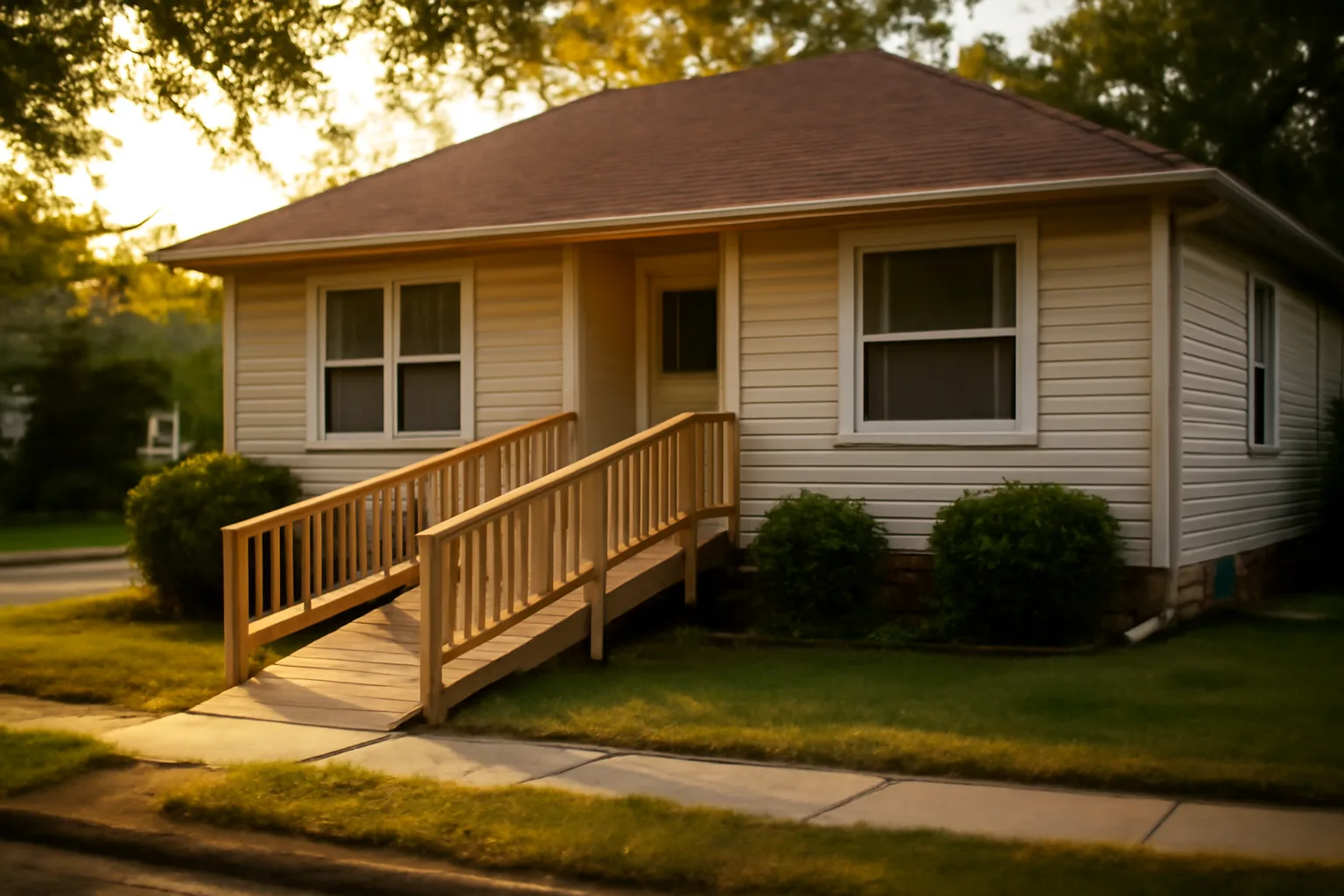
A group home is a residential home, usually a regular house in a regular neighborhood, licensed by a state agency to provide housing plus some level of supervision, personal care, or habilitation services to a small group of unrelated residents. The federal government doesn't define "group home" as a single national category. Instead each state builds its own licensing definition, usually tied to who lives there: people with intellectual or developmental disabilities (IDD), people with serious mental illness, people in substance use recovery, or seniors who need help with daily activities. Most group homes house somewhere between 3 and 10 residents, though the exact cap varies by state and by license type. Group homes are staffed, not self-directed. Staff may be present around the clock or on a scheduled shift basis depending on the acuity of the population and the specific license. The legal backbone that keeps group homes zoned like regular houses (instead of being blocked as "institutional" uses) is the Fair Housing Act, as amended in 1988 to bar discrimination based on disability. HUD's Fair Housing Act overview states the law protects people with disabilities from housing discrimination, including local zoning that singles out group homes for people with disabilities [1]. That's why a well-run group home for 6 adults with IDD generally has the same right to exist on a residential street as a large family. If you're comparing this to a specific state's rulebook, start with your state licensing guides hub, since "group home" gets defined and licensed under completely different statutes depending on where you operate.
What is assisted living?
Assisted living is a distinct, state-licensed category (sometimes called residential care facility, personal care home, or assisted living facility depending on the state) built specifically around housing plus personal care services for people, usually older adults, who need help with activities of daily living but don't need the round-the-clock medical care of a nursing home. CMS describes assisted living residences broadly as they appear in Medicaid Home and Community-Based Services contexts: state-licensed settings that provide room, board, and personal care but are not certified as nursing facilities [2]. Assisted living communities range from small, home-like settings with 6 to 10 residents up to large campuses with 100-plus units. Services typically include help with bathing, dressing, medication reminders, meals, housekeeping, and some coordination of outside medical care. Assisted living is not a nursing home and is not licensed as a medical facility in most states, even though many residences employ nurses or contract with home health agencies for medication management. If a resident's needs escalate to needing daily skilled nursing, a feeding tube, ventilator care, or constant medical monitoring, they usually have to "age out" of assisted living and move to a nursing facility instead, unless the state's regulations allow enhanced or "assisted living with nursing" tiers. For the mechanics of getting licensed in this category specifically, see assisted living facility and assisted living facilities, which cover state-by-state application steps.
What is an assisted living facility, exactly?
An assisted living facility (ALF) is the physical building or licensed operation where assisted living services happen. It's the license holder, more than the service model. States issue the license to a specific address and a specific operator, and that license spells out the maximum resident capacity, the level of care allowed, staffing ratios, and physical plant requirements (fire sprinklers, exit widths, call systems, and so on). Every state has its own name for this. Florida calls it an Assisted Living Facility under Chapter 429 of the Florida Statutes, and requires a license from the Agency for Health Care Administration [3]. California calls the equivalent license a Residential Care Facility for the Elderly (RCFE), licensed by the Department of Social Services [4]. Texas licenses Assisted Living Facilities through the Health and Human Services Commission [5]. The paperwork, inspection frequency, and staffing math differ across all three, even though the resident experience looks similar from the outside. Because the terminology overlaps so much with group homes for other populations, a lot of new operators get confused about which license they actually need. If your target residents are seniors needing help with ADLs, you want the assisted living / RCFE-style license. If your target residents are adults with IDD, serious mental illness, or in recovery, you're usually looking at a different license category entirely (adult foster care, ICF/IID, community mental health residential, or a state-specific group home license), even though the building might look identical. See facility assisted living for a walkthrough of what inspectors check inside these buildings.
What does assisted living provide?
Assisted living provides a mix of housing, personal care, and light health support, but it stops short of skilled nursing. The core service bundle, which shows up in nearly every state's regulatory definition, includes: - Private or shared living unit (room or apartment)
- Three meals a day plus snacks
- Help with activities of daily living: bathing, dressing, grooming, toileting, transferring, and eating
- Medication management or reminders (the exact legal line between "reminding" and "administering" medication varies sharply by state and matters a lot for staffing rules)
- Housekeeping and laundry
- Social and recreational activities
- 24-hour staff availability for supervision and emergencies, though not necessarily a licensed nurse on-site around the clock What assisted living does not typically provide, in most state definitions, is ongoing skilled nursing care, IV therapy, ventilator support, or the kind of medical monitoring a nursing home offers. Some states allow "enhanced" or "limited nursing" assisted living tiers that stretch this boundary, so confirm the exact scope with your state licensing agency before assuming a resident can stay through a medical decline. If you're researching specific markets, senior assisted living facilities near me and assisted living at home cover smaller-footprint and home-based variations of this model.
What's the difference between assisted living and a nursing home?
| Regulator | State licensing agency | State + federal (CMS) | |
|---|---|---|---|
| Medical care level | Non-medical, personal care | Skilled nursing, medical | |
| RN required on-site | Not federally required | Yes, 8 hrs/day minimum (42 CFR 483.35) | |
| Typical setting | Apartment-style or shared room | Hospital-like, shared or private room | |
| Medicare coverage | Generally not covered (see below) | Short-term skilled stays covered under Part A conditions | |
| Medicaid coverage | Often via HCBS waiver, varies by state | Covered as a mandatory Medicaid benefit | People sometimes move from assisted living to a nursing home when their care needs exceed what the assisted living license allows, or when they need rehab after a hospital stay. The reverse move (nursing home to assisted living) happens too, once someone stabilizes and no longer needs skilled care. |
The difference comes down to medical acuity and staffing. Assisted living is a residential, non-medical setting for people who need help with daily tasks but are otherwise stable. A nursing home (skilled nursing facility) is a medical setting for people who need daily skilled nursing care, rehabilitation, or complex medical management. Nursing homes must meet federal requirements to participate in Medicare and Medicaid, including having a registered nurse on duty at least 8 consecutive hours a day, seven days a week, and licensed nursing coverage 24 hours a day, under 42 CFR 483.35 [6]. Assisted living facilities are licensed entirely at the state level and have no equivalent federal staffing mandate; state rules on staffing ratios, med aide training, and nurse delegation vary enormously. | | Assisted Living | Nursing Home (SNF) |
Does Medicare cover assisted living facilities?
No. Medicare does not cover the cost of assisted living, including room and board or personal care services. Medicare.gov states plainly that "Medicare doesn't cover long-term care (also called custodial care)" if that's the only kind of care a person needs [7], and assisted living falls into that custodial category. Medicare Part A will pay for a short-term stay in a certified skilled nursing facility, but only under specific conditions: a qualifying 3-day inpatient hospital stay beforehand, and a doctor-certified need for daily skilled nursing or therapy, with coverage limited to up to 100 days per benefit period and cost-sharing kicking in after day 20 [8]. That coverage is for skilled nursing facilities, not assisted living. Medicaid is a different story, though still limited. Many states cover some assisted-living-type services through Medicaid Home and Community-Based Services (HCBS) waivers, but Medicaid generally cannot pay for the room and board portion of assisted living, only the care services layered on top, per CMS guidance on HCBS waivers [9]. That distinction (services covered, rent not covered) trips up a lot of families and a lot of new operators building a payer-mix assumption into their business plan. For operators, this means your financial model cannot assume Medicare as a payer source for a straight assisted living or group home license. Medicaid waiver reimbursement, VA benefits, long-term care insurance, and private pay are the real levers, and eligibility rules differ by state.
How to start a group home
Starting a group home is a licensing project before it's a real estate project or a hiring project. Skipping ahead to buying a house before you've confirmed the license category is the single most common expensive mistake. 1. Identify your population and license category. "Group home" isn't one license. Confirm with your state licensing agency whether you need an adult foster care license, an IDD group home license, a residential mental health license, a substance use recovery residence certification, or an assisted living / RCFE license. Each has its own statute, application, and inspection standard. 2. Check zoning before you sign a lease or purchase agreement. Group homes for people with disabilities are generally protected under the Fair Housing Act from zoning that treats them worse than an ordinary family household [1], but local occupancy limits, fire code, and spacing requirements between group homes still apply and vary by municipality. Confirm zoning classification with your local planning department, more than the state licensing agency. 3. Write your policy and procedure manual. States require written policies covering admission and discharge criteria, medication management, resident rights, emergency procedures, staffing plans, abuse/neglect reporting, and incident reporting. This document gets reviewed line by line during your licensing survey. 4. Meet the physical plant requirements. Fire marshal sign-off, means of egress, smoke detectors, sprinkler systems (required in many states above a certain resident count), ADA-type accessibility depending on population, and minimum square footage per resident are standard checkpoints. 5. Build your staffing plan. Staff-to-resident ratios, required training hours, background check requirements (most states require FBI and state criminal history checks plus a check against abuse/neglect registries), and CPR/first aid certification all need to be documented before you can pass inspection. 6. Submit the license application and pay fees. Fee amounts, processing timelines, and required attachments (floor plans, fire inspection certificate, proof of financial solvency, criminal background clearances for owners and staff) differ by state; confirm exact figures with your state licensing agency. 7. Pass the pre-licensing inspection. A licensing surveyor will walk the physical building and review your policy manual and personnel files before issuing the initial license. If you want a structured starting point instead of hunting down every state form separately, our $299 State Group Home Licensing Kit organizes the application checklist, policy manual templates, and staffing plan structure by state, so you're not reconstructing this from scratch. It doesn't replace your state's actual application or guarantee approval; only your licensing agency can approve a license.
How do I start a group home if I've never run one before?
If you have no prior operating experience, the honest starting point is working or volunteering inside a licensed group home or assisted living residence for a few months before you apply for your own license. Many states actually require a demonstrated administrator qualification (a certain number of hours of training, a state exam, or a specific credential like an Assisted Living Administrator license) before they'll approve you as the operator of record, so "no experience at all" is a real barrier in a lot of jurisdictions, more than a practical concern. Beyond the experience question, the sequence is the same as above: nail down your license category first, then zoning, then your written policies, then your physical space, then staffing, then the application itself. Trying to do these in a different order (buying a house before confirming zoning, or hiring staff before your policy manual exists) tends to cost people money in the form of lease deposits or renovation work that doesn't match code. Budget realistically for the pre-revenue period. Between securing a compliant property, completing renovations to meet fire and accessibility code, background checks for staff, insurance, and licensing fees, most new operators are carrying real cash costs for months before their first resident moves in and any payment arrives. Confirm your state's specific fee schedule and required minimum working capital (some states require proof of financial solvency as part of the application) with your licensing agency.
How are group homes classified by population served?
Group homes are usually classified by who lives there, because the services, staffing qualifications, and regulatory body differ sharply by population. - IDD group homes: serve adults or children with intellectual or developmental disabilities, often licensed under a state developmental disabilities agency or Medicaid HCBS waiver rules rather than a general health department.
- Adult foster care / adult family homes: small residential settings, often in a family-style home, for seniors or adults with disabilities who need supervision and help with daily living but not skilled nursing.
- Mental health residential group homes: serve adults with serious and persistent mental illness, often licensed through a state behavioral health authority.
- Substance use recovery residences: sometimes called sober living homes, these range from unlicensed peer-run houses to state-certified recovery residences with staffing and oversight requirements.
- Assisted living / RCFE: serves primarily seniors needing help with ADLs, licensed as described above. The practical effect for an operator: your target population determines your regulator, your statute, your staffing credential requirements, and often your Medicaid billing pathway. A building can theoretically be licensed for more than one population type in some states, but usually not without separate applications and separate compliance standards.
What inspections and ongoing compliance should operators expect?
Every licensed group home or assisted living facility goes through an initial licensing inspection and then recurring surveys, typically annual, though the exact frequency and whether inspections are announced or unannounced varies by state. Inspectors typically check three broad areas: the physical plant (fire safety, cleanliness, accessibility, maintenance of the building and grounds), the paper trail (resident files, medication administration records, staff training and background check documentation, incident reports), and direct observation of care (staff interactions with residents, meal service, medication pass). A deficiency in any of these areas usually results in a plan of correction with a deadline, and repeated or serious deficiencies can lead to fines, admission holds, or license revocation depending on the state's enforcement statute. Keeping your policy manual current matters more than most new operators expect. States update regulations periodically, and an outdated manual (referencing a med-aide training requirement that changed, for example) is a common, avoidable citation.
How is a group home different from a boarding house or a sober living home with no license?
The line is the license and the services attached to it. A group home, as covered on this page, holds a state license tied to a specific population and comes with mandatory staffing, training, inspection, and reporting requirements. A boarding house, by contrast, typically just rents rooms with no care services and no license requirement beyond standard landlord-tenant and housing codes. Sober living homes sit in a gray zone in many states. Some states have a voluntary or mandatory certification program for recovery residences (often tied to a national standard like the NARR Standard adopted or referenced by several state agencies), while others have no specific licensing category at all, meaning the home operates more like a boarding house with house rules rather than a licensed care facility. If you're planning to bill Medicaid or accept residents through a court-ordered treatment pathway, you'll almost certainly need the certified/licensed version, not the informal one. Confirm the exact certification landscape with your state's substance abuse or behavioral health agency.
Frequently asked questions
What is assisted living?
Assisted living is a state-licensed residential setting for people, usually seniors, who need help with daily activities like bathing, dressing, and medication management but don't need the skilled nursing care of a nursing home. It provides housing, meals, personal care, and 24-hour staff availability, but it is not a medical facility under most state definitions.
What is a group home?
A group home is a licensed residential home where a small number of unrelated residents, often people with disabilities, mental illness, or care needs, live together with paid staff support. States define and license group homes differently depending on the population served: IDD, mental health, recovery, or senior care each has its own statute and regulator.
What is an assisted living facility?
An assisted living facility is the specific licensed operation and building where assisted living services are delivered. States license it under names like Assisted Living Facility (Florida), Residential Care Facility for the Elderly (California), or similar terms, each with its own capacity limits, staffing rules, and inspection standards.
What's the difference between assisted living and a nursing home?
Assisted living is a non-medical, personal care setting with no federal nursing staffing mandate. A nursing home is a medical facility that must have licensed nursing coverage 24 hours a day and an RN on duty at least 8 hours daily under 42 CFR 483.35. Nursing homes handle higher medical acuity than assisted living is licensed for.
Does Medicare cover assisted living facilities?
No. Medicare does not cover assisted living room, board, or custodial personal care, according to Medicare.gov. Medicare Part A can cover a short-term stay in a certified skilled nursing facility under specific conditions, including a prior 3-day hospital stay, but that's a separate facility type from assisted living.
How do I start a group home?
Start by confirming your exact license category with your state licensing agency (IDD, adult foster care, mental health residential, recovery residence, or assisted living), then check zoning, write your required policy manual, meet physical plant and staffing requirements, and submit your license application with the required fees and attachments.
How much does it cost to start a group home?
Costs vary widely by state, population served, and property, and include licensing fees, renovation to meet fire and accessibility code, background checks, insurance, and working capital during the pre-revenue period. There's no single national figure; confirm the fee schedule and any solvency requirement directly with your state licensing agency.
Does Medicaid pay for assisted living or group homes?
Medicaid can pay for care services in many states through Home and Community-Based Services (HCBS) waivers, but per CMS guidance, Medicaid generally cannot pay for the room and board portion of assisted living. Coverage rules, waiver availability, and what counts as a covered service differ by state.
Is a group home the same thing as assisted living?
Not exactly. "Group home" is a broader term covering licensed residential care for various populations (IDD, mental health, recovery, seniors), while assisted living is a specific license category usually built around seniors needing help with daily activities. The two overlap for senior-focused group homes but diverge for IDD or mental health group homes, which fall under different statutes.
Can a group home operate without a state license?
No, if it provides supervision, personal care, or habilitation services to residents who aren't family members, it almost certainly needs a state license. Operating unlicensed exposes the operator to fines, forced closure, and liability, and blocks access to Medicaid reimbursement. Confirm licensing requirements with your state agency before accepting any resident.
What's the difference between assisted living and independent living?
Independent living is unlicensed senior housing with no required personal care services, essentially an apartment community with amenities. Assisted living is licensed and includes required help with activities of daily living, medication management, and staff supervision. People typically move from independent to assisted living as care needs increase.
What qualifications do you need to run a group home?
Requirements vary by state and license type but commonly include a minimum age, a clean criminal background check, sometimes a specific administrator credential or training hours (an Assisted Living Administrator license, for example), and demonstrated financial solvency. Some states also require prior work experience in a licensed care setting before approving an operator of record.
Sources
- HUD, Fair Housing Act overview: The Fair Housing Act as amended in 1988 protects people with disabilities from housing discrimination, including certain zoning restrictions on group homes
- Medicaid.gov, Home & Community Based Services: Assisted living type settings can be covered as services under Medicaid HCBS programs, distinct from nursing facility care
- Florida Statutes, Chapter 429 (Assisted Living Facilities): Florida licenses Assisted Living Facilities under Chapter 429 through the Agency for Health Care Administration
- California Department of Social Services, Community Care Licensing: California licenses assisted living type settings for seniors as Residential Care Facilities for the Elderly (RCFE)
- Texas Health and Human Services, Assisted Living Facilities: Texas licenses Assisted Living Facilities through the Health and Human Services Commission
- Electronic Code of Federal Regulations, 42 CFR 483.35: Nursing homes must have an RN on duty at least 8 consecutive hours a day, 7 days a week, and licensed nursing coverage 24 hours a day
- Medicare.gov, Long-term care coverage: Medicare doesn't cover long-term custodial care, which is the category assisted living falls under
- Medicare.gov, Skilled nursing facility care coverage: Medicare Part A covers a skilled nursing facility stay under specific conditions including a qualifying 3-day hospital stay, with cost-sharing after day 20 and a 100-day limit per benefit period
- Medicaid.gov, Home and Community Based Services 1915(c) waivers: Medicaid HCBS waivers can cover care services in residential settings but generally cannot pay for room and board