Last updated 2026-07-25
TL;DR
Starting a small group home means picking a population to serve, forming a business entity, finding zoning-compliant property, writing policy manuals, hiring qualified staff, and passing your state licensing agency's application and inspection process. Timelines and fees vary by state and by license type (adult foster care, IDD, mental health, or residential assisted living), so confirm specifics with your state licensing agency before you sign a lease.
What is a group home?
A group home is a licensed residential setting where a small number of people, usually somewhere between 3 and 10 depending on the state, live together and receive some level of supervision, personal care, or support services from paid staff. It is not a hospital and it is not someone's private home in the legal sense once it is licensed. It sits in a category regulators call "residential care" or "community-based care," and the exact rules depend entirely on which population the home serves and which state you're in. Group homes exist for several distinct populations, and each one has its own licensing category, its own staffing ratios, and often its own state agency. Adult foster care homes serve seniors or adults with disabilities who need daily support but not skilled nursing. Intellectual and developmental disability (IDD) group homes serve people with conditions like autism, Down syndrome, or cerebral palsy, often funded through a state's Medicaid Home and Community-Based Services (HCBS) waiver. Mental health group homes serve adults managing conditions like schizophrenia or bipolar disorder who need a structured living environment. Recovery residences serve people in early sobriety. Senior residential assisted living (RAL) homes, sometimes called adult family homes, serve older adults who need help with bathing, medication, and meals but not 24-hour nursing. The federal government does not license group homes directly. Licensing is a state and sometimes county function, which is why the term "group home" means something different in California than it does in Texas. If you want a primer on the licensing category most people confuse with a group home, see assisted living.
What is assisted living?
Assisted living is a residential care model for people, usually older adults, who need help with daily activities like bathing, dressing, medication management, and meals, but who do not need the round-the-clock skilled nursing that a nursing home provides. Assisted living communities range from small homes with 3 to 6 residents up to large buildings with over 100 units, and both ends of that range fall under the same broad regulatory umbrella in most states even though the paperwork looks completely different. The Centers for Medicare & Medicaid Services (CMS) does not directly regulate assisted living because it is a state-licensed, non-medical model of care rather than a Medicare or Medicaid provider type in the way a nursing facility is. States use their own terms: "residential care facility," "assisted living facility," "personal care home," or "adult family home." If you're building a small operation rather than a large community, read assisted living facility and facility assisted living for how the license category maps to a small home model.
What is an assisted living facility?
An assisted living facility (ALF) is the licensed building or home where assisted living services are delivered. The term is a regulatory label, more than a marketing phrase; when a state inspector uses it, they mean a specific license type with a specific chapter of code behind it. Florida, for example, licenses assisted living facilities under Chapter 429 of its statutes and requires a facility to hold a license issued by the Agency for Health Care Administration before admitting a single resident [1]. Most states set minimum physical plant standards for an ALF: minimum square footage per resident bedroom, a maximum number of residents per room (often two), accessible bathrooms, and fire and life-safety features like sprinklers or smoke detectors tied to occupancy classification. A 6-bed home in a converted single-family house has to meet nearly all the same fire code and staffing documentation requirements as a 60-bed purpose-built community, just scaled down. That is the part first-time operators underestimate the most: small does not mean simple.
What does assisted living provide?
Assisted living provides help with activities of daily living (ADLs), which include bathing, dressing, toileting, transferring (moving from bed to chair), continence care, and eating. Beyond ADLs, most assisted living licenses also cover medication management or administration (depending on state rules about who can legally hand out pills), three meals a day, housekeeping, laundry, social and recreational activities, and 24-hour staff availability for supervision and emergencies. What assisted living does not typically provide is skilled nursing care, IV therapy, ventilator support, or complex wound care, though some states allow "enhanced" or "limited nursing" tiers of licensure that stretch that line a little. If a resident's needs escalate past what the license allows (a common trigger is needing two-person transfer assistance, developing a stage 3 or 4 pressure ulcer, or requiring skilled nursing visits more than a few times a week), most state rules require the home to either get a waiver, arrange outside skilled services, or discharge the resident to a higher level of care. Check your state's specific "negotiated risk" or "appropriateness of placement" rule before you accept a resident whose needs are borderline.
How do I start a group home? (the full sequence)
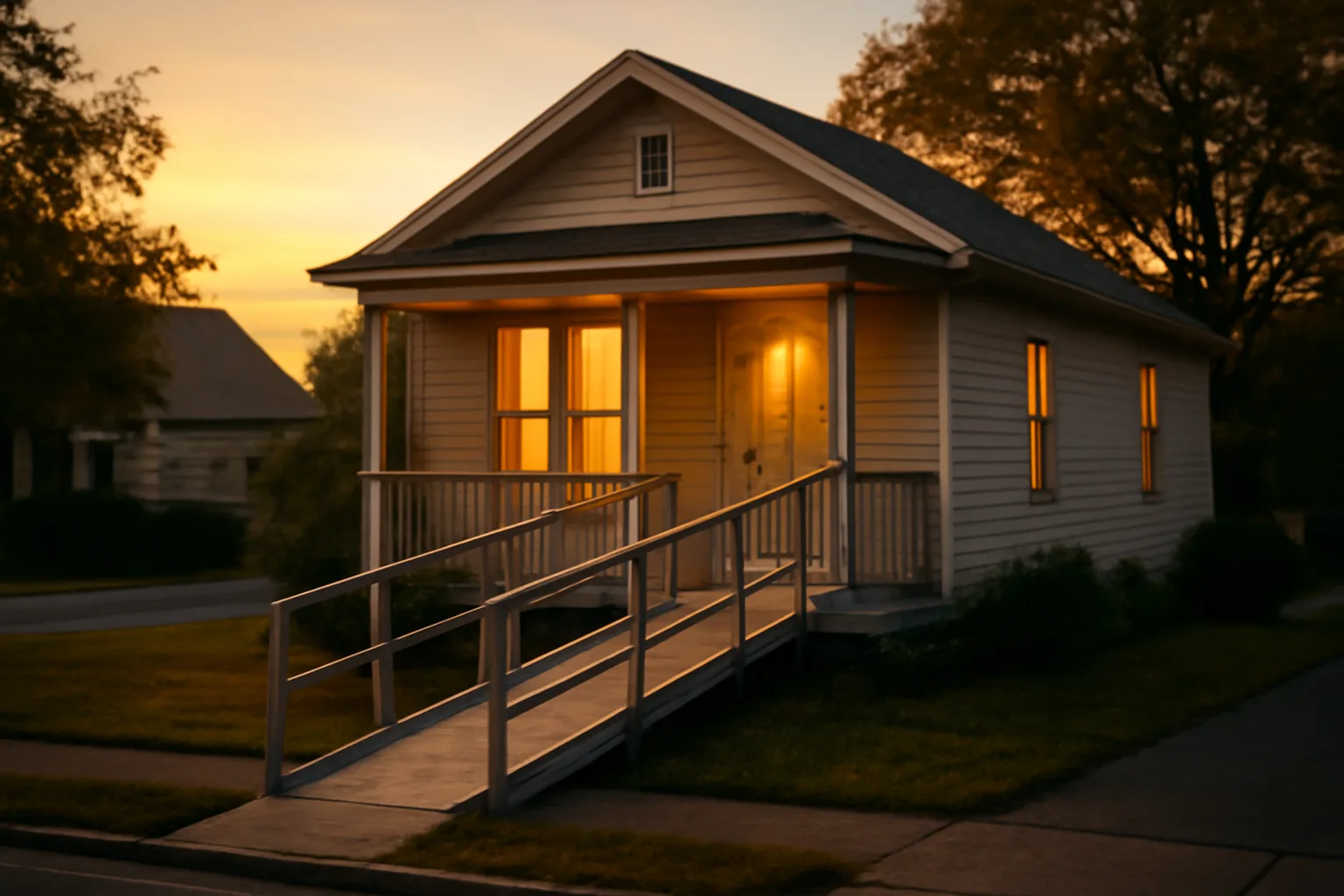
Starting a group home follows roughly the same eight-step sequence in every state, even though the specific forms and agencies differ. Here is the order that actually works, based on how state licensing statutes are structured. 1. Pick your population and license type. Decide whether you're serving seniors (assisted living / adult foster care), adults with IDD, adults with mental illness, or people in recovery. This decision drives everything downstream: which agency licenses you, what your staff-to-resident ratio must be, and what funding sources (private pay, Medicaid waiver, state mental health authority contract) are even available to you. 2. Form your business entity. Most states require the licensee to be a legal entity (LLC or corporation), not an individual, though solo adult foster care providers in some states can operate as sole proprietors. Register with your Secretary of State and get an EIN from the IRS before you file anything with the licensing agency, because most license applications ask for your entity's formation documents. 3. Confirm zoning before you sign a lease or make an offer. A group home for 6 or fewer unrelated people with disabilities is generally protected as a "single-family use" under the federal Fair Housing Act. The Fair Housing Act makes it unlawful to discriminate in housing based on disability, and HUD's implementing regulations at 24 CFR 100.201 define "reasonable accommodation" in a way that courts have applied to bar cities from using zoning to exclude small group homes from residential neighborhoods on the same terms as unrelated families [2]. Homes above that threshold, or homes seeking a special use permit anyway, still need to go through your local zoning or planning department. Never sign a lease contingent only on "license approval"; make it contingent on a written zoning determination too. 4. Write your policy and procedure manual. Every state licensing application requires a written operations manual covering admission and discharge criteria, medication management, emergency and disaster planning, resident rights, grievance procedures, staff training, and incident reporting. This is the single most time-consuming piece of the application for first-time operators, and it's also the document inspectors return to again and again during your annual survey. 5. Build your staffing plan. States set minimum staff-to-resident ratios and required background check types (often a state criminal history check plus a federal FBI fingerprint check, and in many states a check against the state's abuse and neglect registry). Budget for CPR/First Aid certification, medication administration training if your state requires it, and orientation hours before a new hire can work an unsupervised shift. 6. Get your building inspected for fire and life safety. Your local fire marshal and, in many states, a separate state fire safety inspector will check egress routes, smoke detectors, fire extinguishers, and in some cases automatic sprinklers depending on occupancy classification and resident mobility. This inspection often has to be completed and passed before your licensing agency will schedule its own survey. 7. Submit your license application and pay fees. Application fees, background check fees, and initial licensing fees vary by state and by bed count; confirm current amounts with your state licensing agency because these numbers change and differ by license category. 8. Pass your pre-licensure inspection. A surveyor from your state licensing agency visits the physical location, reviews your policy manual, checks staff files, and confirms life-safety compliance before issuing your initial license. Many states issue a provisional or probationary license for the first 6 to 12 months rather than a full license, with a follow-up inspection before renewal. For state-specific application steps, see assisted living facilities and senior assisted living facilities near me, which break down licensing agency contacts by category.
What is the difference between assisted living and a nursing home?
| Regulator | State licensing agency | State agency + federal CMS certification | |
|---|---|---|---|
| Care level | Non-medical ADL support | Skilled nursing, 24-hour medical care | |
| RN requirement | Varies by state, often none required on-site | At least 8 hrs/day, 7 days/week under 42 CFR 483.35 [3] | |
| Typical setting | Home-like, private or semi-private room | Hospital-like, often shared rooms | |
| Medicare coverage | Not covered as room and board | Covered short-term after qualifying hospital stay | If you're deciding which license to pursue for your own building, assisted living at home covers how small residential settings differ from institutional nursing facilities in both licensing burden and buildout cost. |
The core difference is the level of medical care and the regulatory framework behind it. Assisted living is a non-medical, state-licensed residential model built around help with daily living tasks. A nursing home (also called a skilled nursing facility, or SNF) is a medical care setting, certified under federal Medicare and Medicaid rules, that provides 24-hour skilled nursing care, physician oversight, and rehabilitation services like physical therapy after a hospitalization. Nursing homes must meet federal requirements under 42 CFR Part 483 to participate in Medicare and Medicaid, including having a registered nurse on duty at least 8 consecutive hours a day, 7 days a week [3]. Assisted living facilities have no equivalent federal requirement; staffing rules come entirely from state law, and many states do not require a nurse on-site at all, only "on call" or available by phone. | Feature | Assisted living | Nursing home |
Does Medicare cover assisted living facilities?
No. Medicare does not cover the cost of room and board in an assisted living facility. Medicare.gov states plainly that Medicare "doesn't cover long-term care (also called custodial care)" if that's the only care needed, and assisted living room and board falls squarely into that custodial category [4]. What Medicare will cover, even for someone living in an assisted living facility, is medically necessary services delivered under Medicare Part A or Part B: doctor visits, physical therapy ordered by a physician, durable medical equipment, and short-term skilled nursing after a qualifying hospital stay (though that skilled care typically happens in a certified SNF, not the assisted living building itself). Medicaid is a different story. Many states use a Medicaid HCBS waiver to cover the *service* component of assisted living or adult foster care, personal care, medication management, that kind of thing, even though room and board still generally has to be paid privately or through Supplemental Security Income (SSI) and state supplemental payments. CMS's HCBS waiver page explains that these waivers let states pay for home and community-based services as an alternative to institutional care for people who would otherwise qualify for a nursing facility level of care [5]. This distinction, service costs versus room-and-board costs, is one of the most common points of confusion for new operators building a funding model, so map it out state by state before you assume Medicaid will cover your whole rate.
How much does it cost and how long does it take to license a small group home?
There is no single national number, and any article that gives you one flat figure is guessing. Costs and timelines depend on your state, your license category, your bed count, and whether your building needs construction or just minor retrofits. What is true across states is the shape of the cost: application and background check fees are usually a few hundred dollars, building retrofits (sprinklers, egress doors, ADA-compliant bathrooms) are usually the largest line item, and the licensing survey itself is free but can trigger a costly correction-and-reinspection cycle if you're not ready. A realistic planning approach is to build three cost buckets: entity and legal setup (a few hundred to a couple thousand dollars for LLC formation, EIN, and possibly an attorney review of your lease), physical plant compliance (highly variable, can run from a few thousand dollars for minor fixes to well over $50,000 for a home that needs a sprinkler retrofit), and licensing/application fees plus staff training and background checks (typically a few hundred to a few thousand dollars depending on state and bed count). Confirm every one of these figures with your state licensing agency and your local fire marshal before you commit to a property, because a home that looks perfect on Zillow can fail zoning or fire code in ways that cost more to fix than the building is worth. Timelines run anywhere from a few months to over a year, mostly driven by how fast your building passes fire and life-safety inspection and how complete your policy manual is on first submission. Agencies routinely bounce applications back for missing documentation, so a clean, complete first submission is the single biggest lever you control.
What paperwork actually gets rejected, and how do you avoid it?
State licensing surveyors see the same mistakes over and over. Incomplete background checks (missing a required federal fingerprint check alongside the state check) is one of the most common. Policy manuals copied from another state's template without updating citation numbers or agency names is another; a surveyor who sees a reference to the wrong statute chapter assumes the whole document was rushed. Zoning is the other frequent trap. Operators sign a lease before confirming with the local planning department that a group home use is permitted as-of-right or through the reasonable-accommodation process protected under the Fair Housing Act [2], then discover months later that a special use permit hearing is required, adding another 60 to 180 days before they can even submit their state license application. Building a compliant application packet from scratch, state statute by state statute, is genuinely one of the more tedious parts of this whole process, which is part of why we built the $299 State Group Home Licensing Kit at GroupHomePath's licensing kit builder, a one-time toolkit with state-specific checklists and policy manual templates so you're not starting from a blank page. It doesn't replace reading your state's actual regulations, and it doesn't promise a particular outcome with your licensing agency; no legitimate product can. It just gets your paperwork organized before you walk into your first inspection.
What staffing and training does a small group home need?
Nearly every state requires a designated "administrator" or "licensee-in-charge" who completes a state-approved training course before the home can open, often 40 to 100 hours depending on the license category and state. Direct care staff typically need CPR and First Aid certification, a background check (state criminal history plus, in most states, a federal fingerprint-based FBI check), and orientation covering resident rights, infection control, emergency procedures, and abuse reporting requirements before working an unsupervised shift. Staff-to-resident ratios vary by license type and by time of day; a home might require one awake staff member per 8 residents during the day and one per 15 overnight, or ratios could look completely different depending on your state and whether residents have higher acuity needs. Confirm your state's specific ratio requirements before you build a staffing budget, because getting this wrong is both a licensing violation and, more importantly, a resident safety issue.
What's the fastest path if you're licensing your first small home?
There is no legitimate fast-track. Any consultant or course promising a specific guaranteed timeline to licensure is not being straight with you, because your state licensing agency controls that timeline, not a private company. What you can control is preparation quality: confirm zoning in writing before signing a lease, submit a complete policy manual on the first try, schedule your fire marshal walk-through early, and have staff background checks initiated the day you make a conditional job offer rather than after. The operators who move fastest are the ones who read their state's actual licensing statute and administrative code before spending a dollar on a building, then build their application around what the statute actually requires rather than what a template from a different state assumes. Start with your state licensing agency's own published application checklist; it is the one document that is always accurate.
Frequently asked questions
What is assisted living?
Assisted living is a state-licensed residential care model for people, usually older adults, who need help with daily activities like bathing, dressing, and medication but do not need 24-hour skilled nursing. It ranges from small homes with a handful of residents to large communities with over 100 units, and it is regulated at the state level, not federally.
What is a group home?
A group home is a licensed residential setting where a small number of people, often 3 to 10 depending on the state, live together and receive supervision or support services from paid staff. Group homes serve specific populations including seniors, people with intellectual or developmental disabilities, people with mental illness, and people in addiction recovery.
What is an assisted living facility?
An assisted living facility (ALF) is the licensed building where assisted living services are provided. It's a regulatory term tied to a specific state license, such as Florida's Chapter 429 assisted living facility license issued by the Agency for Health Care Administration, and it requires meeting building, staffing, and care standards before residents can be admitted.
What does assisted living provide?
Assisted living typically provides help with bathing, dressing, toileting, medication management, meals, housekeeping, laundry, social activities, and 24-hour staff availability. It does not usually provide skilled nursing, IV therapy, or complex wound care; residents whose needs exceed those limits often have to move to a nursing home or receive outside skilled services.
What is the difference between assisted living and a nursing home?
Assisted living is non-medical residential care licensed at the state level with no federal nurse-staffing mandate in most states. A nursing home is a medically focused, federally certified facility required under 42 CFR 483.35 to have a registered nurse on duty at least 8 hours a day, 7 days a week, and it accepts Medicare payment for short-term skilled care.
Does Medicare cover assisted living facilities?
No. Medicare does not cover room and board in assisted living because it is classified as custodial, long-term care. Medicare can cover medically necessary services like doctor visits or physician-ordered therapy even for someone living in assisted living, but not the facility's daily rate itself.
How do I start a group home?
Pick your population and license type, form a business entity, confirm zoning before signing a lease, write your policy and procedure manual, build a compliant staffing plan, pass fire and life-safety inspection, submit your application with required fees, and pass your state's pre-licensure survey. Every step routes through your state licensing agency, and requirements vary significantly by state and license category.
How much does it cost to start a small group home?
There's no single national figure. Costs break into entity/legal setup (a few hundred to a couple thousand dollars), physical plant compliance (highly variable, potentially tens of thousands for retrofits like sprinklers), and licensing/training fees (typically a few hundred to a few thousand dollars). Confirm exact fee schedules with your state licensing agency.
How long does it take to get a group home licensed?
Timelines commonly run from a few months to over a year, driven mostly by how quickly the physical building passes fire and life-safety inspection and how complete the policy manual is on first submission. Incomplete applications and zoning surprises are the two biggest causes of delay.
Do I need a special zoning permit for a group home?
It depends on size and state law. Group homes for 6 or fewer unrelated residents with disabilities are generally protected under the Fair Housing Act as a residential use similar to a family living together, meaning cities generally cannot single them out for exclusion. Larger homes, or any home a local zoning code treats differently, may need a conditional use permit; confirm with your local planning department.
What background checks does a group home need for staff?
Most states require a state criminal history background check plus a federal fingerprint-based FBI check for anyone providing direct care, and many states also check a state abuse and neglect registry. Requirements and disqualifying offenses differ by state and by license category, so confirm specifics with your state licensing agency.
Can a group home be run out of a regular house?
Yes, many small group homes operate out of converted single-family houses, and this is common for adult foster care and small residential assisted living models. The house still has to meet the state's physical plant standards (bedroom size, bathroom accessibility, egress routes) and pass fire marshal inspection, so not every house qualifies without retrofits.
What's the difference between adult foster care and a group home license?
Adult foster care is often a smaller-scale license category, sometimes for as few as 1 to 5 residents in a caregiver's own home, while "group home" broadly covers larger staffed residential settings. The dividing line and terminology differ by state, so check how your state licensing agency defines each category before choosing which application to file.
Sources
- Florida Agency for Health Care Administration, Chapter 429 Florida Statutes: Florida licenses assisted living facilities under Chapter 429 and requires a license before admitting residents
- eCFR, 24 CFR 100.201 Reasonable accommodation definitions: HUD's Fair Housing Act regulations define reasonable accommodation in a way applied to protect small group homes from exclusionary zoning
- eCFR, 42 CFR 483.35 Nursing services: Nursing homes must have a registered nurse on duty at least 8 consecutive hours a day, 7 days a week
- Medicare.gov, Long-term care coverage: Medicare does not cover long-term custodial care such as assisted living room and board
- CMS, Home and Community-Based Services 1915(c) waivers: States use Medicaid HCBS waivers to pay for community-based services as an alternative to institutional care
- 42 U.S.C. 3604, Fair Housing Act discriminatory practices: The Fair Housing Act makes it unlawful to discriminate in housing based on disability, the basis for group home zoning protections